


Check the Kp-index, the Bz reading, the Sodankylä magnetometer, and your local cloud forecast together, not one at a time. If all four line up for your part of Finland, go outside. If even one is off, especially clouds, wait. Lapland needs a lower Kp threshold than southern Finland, and no forecast, however good, guarantees a sighting.
TL;DR:
- Checking multiple signals such as Kp-index, Bz, local magnetometer data, and cloud cover is essential to accurately predict aurora visibility, especially in Finland.
- Lapland can display visible auroras at much lower Kp indices (as low as 2 or 3) than southern Finland, where Kp 5 or higher is generally required.
- A sustained negative Bz value over several hours is more promising than brief spikes, and cloud cover can easily ruin even the strongest geomagnetic signals.
- Reliable forecasting requires real-time checks of magnetometer trends, local weather, and sky horizon conditions within the last hour before heading out.
- Using trusted Finnish tools like FMI, Sodankylä observatory, and local cloud maps improves decision accuracy over relying on single indices or long-term forecasts alone.
Table of Contents
- Understanding revontuliennuste käyttö: what “using” an aurora forecast actually means
- Five-minute checklist to run before heading out tonight
- How do Kp, Bz, and solar wind actually work?
- Why clouds and moonlight can ruin a perfect Kp reading
- Which Finnish tools should you actually trust?
- What to check 3 hours, 1 hour, and 30 minutes before you go
- Camera settings and field tricks that actually help
- Why forecasts more than a day out are still unreliable
- What guests get wrong about chasing lights in Lapland
- Book a stay built around aurora nights, not guesswork
- Sources
Understanding revontuliennuste käyttö: what “using” an aurora forecast actually means
Most people treat an aurora forecast like a weather app: open it, see a number, decide. That habit fails constantly in Finland, and it’s why so many visitors drive an hour north, stand in a parking lot for twenty minutes, and see nothing but stars.
Proper revontuliennuste käyttö means reading several signals at once rather than trusting a single index. The Kp-index tells you how disturbed Earth’s magnetic field is globally. The Bz value tells you whether the solar wind can actually connect with that field. Local magnetometer data from Sodankylä tells you what’s happening right now over Finnish soil. And none of it matters if a cloud bank sits over your horizon.
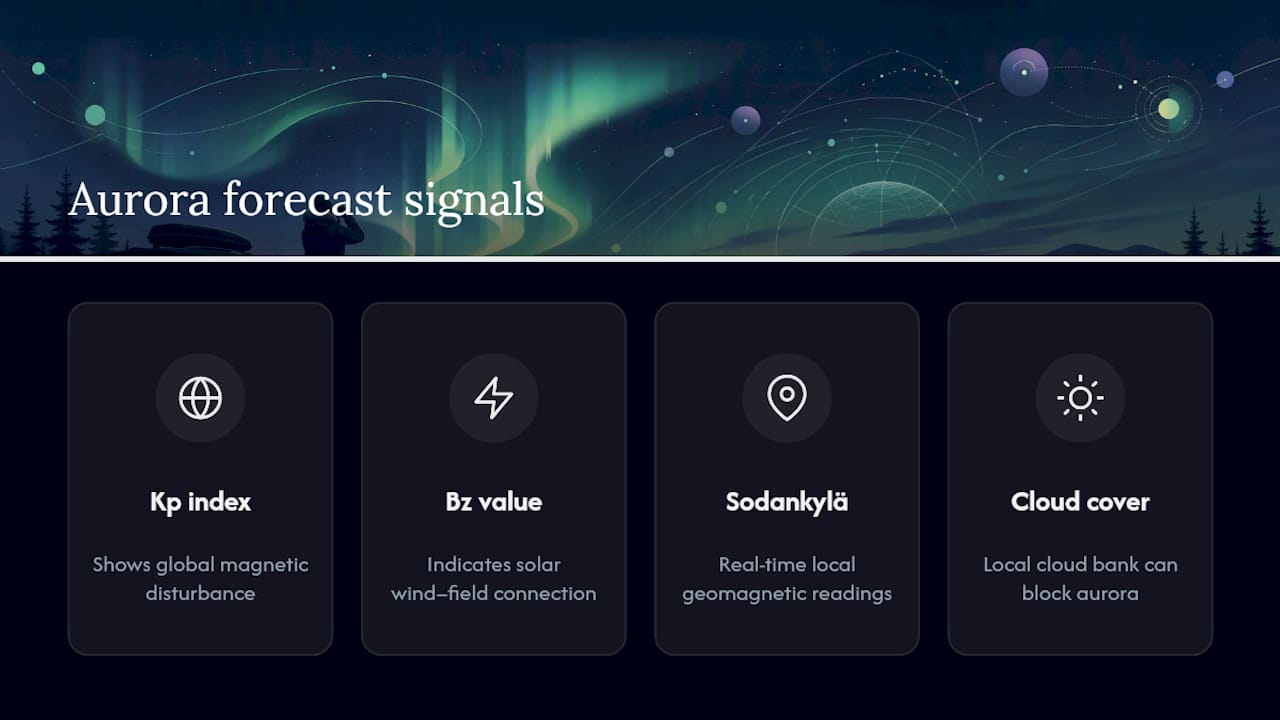
This guide walks through each signal, where to check it, and how to combine them into a five-minute decision you can run before every potential aurora night. Think of it less as forecasting and more as triangulation: three or four imperfect signals pointing at the same conclusion beat one confident-looking number.
Five-minute checklist to run before heading out tonight
Run this sequence in order. Skipping steps is how people end up chasing a false alarm.
- Open the Finnish Meteorological Institute’s aurora page or RWC Finland’s probability map for tonight’s general outlook.
- Check the Sodankylä magnetometer trace for recent spikes or a steadily climbing baseline.
- Look at the Bz value and its trend over the last hour, not just the current number.
- Confirm a cloud gap over your specific location using Open-Meteo or FMI’s local forecast.
- Check the moon phase and whether your viewing spot has a clear north horizon.
- Confirm your route and parking plan if you’re driving somewhere remote.
Pro Tip: Bookmark the Sodankylä magnetometer and your local Open-Meteo cloud map side by side. If the magnetometer is climbing but your sky map shows solid cloud, save the drive for another night.
How do Kp, Bz, and solar wind actually work?
The Kp-index runs from 0 to 9 and measures global geomagnetic disturbance, not what’s overhead in your backyard. In Finland, Kp 5 or higher is a reasonable trigger to start checking other signals if you’re in the south, while Lapland can produce visible auroras at Kp 2 or 3 under clear skies. That gap surprises a lot of first-time chasers who assume one number applies everywhere in the country.
Bz matters more than most people realize. It measures the north-south orientation of the interplanetary magnetic field, and a sustained southward, or negative, Bz is what actually lets solar particles connect with Earth’s magnetosphere. A brief dip to negative 5 for ten minutes is far less promising than a steady negative 8 held for two or three hours.
- Kp-index: global activity level, useful as a first filter, not a final answer
- Bz: direction and duration matter more than a single spike
- Solar wind speed and density: fast streams (500+ km/s) often signal a coronal hole stream that can sustain activity for a day or two, while sudden density jumps can flag an incoming coronal mass ejection
- Sodankylä magnetometer: near-real-time confirmation of what’s actually happening over Finland
Beginners routinely misuse Kp as a straightforward go or no-go signal. Aurora Hunt’s own guidance is blunt about this: treat Kp as a filter, then check Bz, clouds, and local visibility before you decide anything. Experienced chasers also watch the trend and duration of a southward Bz rather than fixating on the single highest number of the night, since a sustained negative reading for hours tends to outperform a brief spike.
Why clouds and moonlight can ruin a perfect Kp reading
A strong geomagnetic signal means nothing under a solid cloud deck. Ilmatieteen laitos and Ursa both stress that clear skies and a dark horizon are non-negotiable for actually seeing anything, regardless of how promising the space weather looks.
- Check cloud type and altitude, not just cloud percentage; thin high cirrus can still let faint color through, while low stratus blocks everything
- A near-full moon washes out fainter displays, so treat a bright moon as a reason to want a higher Kp before committing
- Pick a spot with an open north-facing horizon and minimal light pollution; a practical Lapland viewing guide can help you scout locations in advance
- When the two signals conflict, favor the cloud gap over a marginally higher Kp reading almost every time
Pro Tip: A moderate Kp with a genuinely clear sky beats a high Kp under scattered cloud. Auroras you can’t see don’t count.
Which Finnish tools should you actually trust?
A handful of sources cover almost everything you need, and each does one job well.
- Ilmatieteen laitos (FMI): the official source for Finnish auroral probability and general viewing guidance
- RWC Finland (Avaruussääkeskus): magnetometer plots and short-term activity maps built specifically for Finland
- Sodankylä Geophysical Observatory: the magnetometer and camera feed that gives you ground truth over Lapland in near real time
- Ursa: Finland’s astronomical society, useful for community observation reports and dark-sky guidance
- NOAA SWPC: the 30-minute aurora forecast and geomagnetic dashboards, a solid supplementary feed once you’ve checked Finnish sources first
- Open-Meteo: your cloud-cover check, paired with FMI’s local weather forecast
What to check 3 hours, 1 hour, and 30 minutes before you go
- Three hours out: scan the one to three day outlook, check tonight’s moon phase, and identify likely cloud gaps in your area.
- One hour out: look at the Kp trend line, not just the current value, and check whether Bz has turned and stayed negative.
- Thirty minutes out: confirm the cloud gap is holding, finalize your route and warm clothing, and get your camera or phone ready.
- Zero minutes: do a last check of the Sodankylä magnetometer and any nearby all-sky camera feed, then decide.
This routine works whether you’re stepping onto a hotel balcony or driving forty minutes to a dark field. The best timing windows for Lapland shift seasonally, so pair this hourly routine with a sense of which months give you the longest dark window to work with.
Camera settings and field tricks that actually help
Once you’re outside, a quick test shot settles most doubts faster than staring at the sky. A short long-exposure photo, even on a phone, reveals faint aurora color that your eyes haven’t adapted to see yet.
- For DSLRs, start around f/2.8, ISO 1600 to 3200, and a 5 to 15 second exposure, adjusting for how bright the display is
- Use a tripod and, if your camera supports it, interval shooting to capture the sky changing over several minutes
- Preserve your night vision with a dim red light rather than a phone screen at full brightness
- Layer clothing heavily and park somewhere you can retreat to warmth quickly
Auroras usually show structure and movement, drifting curtains or pulsing bands, while skyglow and cloud stay flat and static. A general guide to dark-sky stargazing technique covers useful fieldcraft that applies just as well to aurora hunting as to general night-sky viewing.
Why forecasts more than a day out are still unreliable
One to three day forecasts model where solar wind is heading, and the timing uncertainty on those models is real. The direction of Bz, the single most decisive factor for visibility, is often only knowable 30 to 60 minutes before the solar wind actually reaches Earth, because that’s roughly the lead time satellites parked at the L1 point give us.
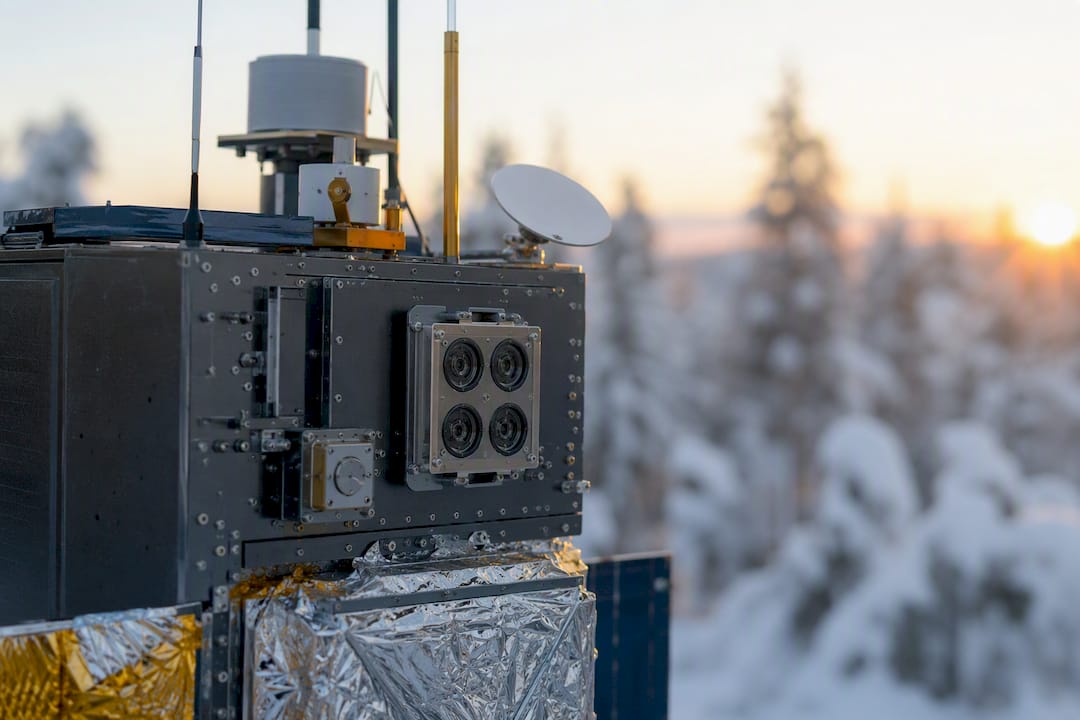
That’s why ground magnetometers and camera feeds beat any multi-day outlook for a same-night decision. Set your expectations accordingly: a three-day forecast tells you which nights are worth watching, but only the last hour of data tells you whether to actually go outside.
What guests get wrong about chasing lights in Lapland
Hospitality teams in Pyhä-Luosto run the same checklist guests do: probability outlook, Bz trend, a cloud window, and a safety plan before anyone leaves the building. The difference is experience reading the noise, not access to secret data.
Guiding a group changes the calculus, too. Comfort, warm layers, and a safe route matter as much as the geomagnetic numbers, and that’s true whether you’re staying with us or heading out on your own with this same checklist.
— Juho
Book a stay built around aurora nights, not guesswork
Running Kp, Bz, and cloud checks yourself works, but it takes practice and a few clear nights before the pattern clicks. Sundaymorning gives you a shortcut: our team in Pyhä-Luosto watches the same Finnish sources every evening and builds guided outings around the nights that actually look promising, so you’re not standing outside checking a phone screen at midnight.
Staying with us means aurora-aware accommodation with genuine sightlines to the northern sky, plus guided outings timed to real conditions rather than a fixed evening slot. You still get the independence to step outside and look up whenever the magnetometer spikes. If you’d rather have someone else run the checklist, browse our luxury accommodation in Lapland and check available dates for your trip.
Sources
- Auroras in Finland — Finnish Meteorological Institute (FMI)
- Revontulten ennustaminen — Ilmatieteen laitos
- Kp-indeksi ja revontulet — Aurora Hunt
- Avaruussää Suomessa — RWC Finland
