


Yes, you can charge an electric car across Lapland, and the network is more capable than most first-time visitors expect. Plan your route between major towns, and you’re set. Here’s what you need to know before you go:
- Charger types: mostly AC destination chargers (11–22 kW) at hotels and cabins, common 50 kW DC fast chargers along main routes, and a handful of high-power hubs (100–350 kW) at select tourist stops.
- Planning tools: Latauskartta, ChargeFinder, and PlugShare show live charger locations and status.
- App prep: install operator apps like Plugit Cloud before you leave cell coverage behind. Lapland’s distances are real, but so is its charging network.
Table of Contents
- How Big Is the Sähköauto Lataus Network in Lapland?
- Where Do You Find Chargers Before You Drive?
- What Charging Speeds Should You Expect?
- How Do You Handle Winter Charging in the Arctic?
- How Do You Plan a Charging Route Between Towns?
- What Should You Ask Your Hotel About EV Charging?
- What Do You Do If a Charger Is Out of Service?
- How Much Does Cold Weather Slow Down Charging?
- Sources
How Big Is the Sähköauto Lataus Network in Lapland?
Lapland’s charging infrastructure has grown from scattered outlets to a genuine regional network. NEVE alone operates about 30 charging points across the region, and NEVE reports roughly 200 public charging points total in Lapland when you count every operator.
By the numbers: PlugShare lists several hundred public charging stations across Lapland, with dozens of DC fast chargers scattered between towns.
Most chargers cluster where people actually stop:
- Town centers in Rovaniemi, Sodankylä, and Kittilä
- Service stations along the main E75 and E8 routes
- Hotels and tourist hubs like Saariselkä and Ivalo
Expansion continues each year, and operators add capacity ahead of peak winter tourist season, when demand on popular routes spikes hard. Expect the network to look different by next winter than it does today.
Where Do You Find Chargers Before You Drive?
Three tools do most of the work. Latauskartta.fi gives you a Finland-wide live map with real-time status per charger. ChargeFinder overlays route planning with charger locations, useful when you’re mapping a multi-day Lapland loop. PlugShare adds crowdsourced reviews, so you know if a station near Inari has been reliable lately or if drivers have flagged problems.
Set yourself up properly before you leave cell coverage behind:
- Download latauskartta.fi, ChargeFinder, and PlugShare and check them against each other for your route.
- Install operator apps, including Plugit Cloud and Virta, and add a payment method to each while you still have solid WiFi.
- Log in once to confirm your account works. A login failure at a remote charger with no signal is a bad time to discover a typo in your password.
- Save a backup list of charger locations along your route, plus operator support numbers.
Pro Tip: Keep a paper or offline note of two or three backup charger locations per leg. Apps crash, coverage drops, and a saved screenshot of a map has saved more than one Lapland road trip.
Bring your own Type 2 cable if your car doesn’t include one permanently, and pack a CCS adapter if your vehicle needs one for DC fast charging.
What Charging Speeds Should You Expect?
Charger type determines how long you’ll wait, and Lapland runs a full spectrum:
- AC destination chargers (11–22 kW): the most common type at hotels and cabins, ideal for overnight charging while you sleep.
- DC fast chargers (50 kW): the workhorse along main routes, delivering a meaningful top-up in 30 to 60 minutes.
- High-power chargers (100–350 kW): available at select tourist hubs, with some Lapland locations now offering 240 kW and up to 350–400 kW capability.
Your actual charging time depends on more than the station’s rated power. Vehicle acceptance rate caps how fast your battery can take a charge regardless of what the station offers, and cold temperatures slow that rate further. A station’s real-world condition matters too. A 150 kW charger delivering 90 kW on a cold January afternoon is a normal outcome, not a malfunction.
How Do You Handle Winter Charging in the Arctic?
Cold weather changes the math on range and charging speed, so plan around it rather than against it.
- Plan on 300–400 km of real-world range, even if your car’s rated range is higher, and keep a 20–30% buffer rather than running toward empty.
- Precondition your battery before charging when your car supports it. A cold battery charges slowly; a warmed one accepts power far faster.
- Charge before long cold stretches, not after. Starting a remote leg at 90% beats starting at 40% and hoping.
- Avoid draining to near-zero in subzero temperatures. Very low charge combined with deep cold can affect how the battery performs and how it’s protected internally.
- Expect extra steps at some chargers. Certain stations require a physical button press after you authorize through the app, a quirk that trips up first-time users on remote Plugit-hosted units.
Pro Tip: Save two or three operator support phone numbers in your contacts before you leave town. A five-minute call beats a two-hour wait when a charger won’t authorize and you’re the only car at the station.
Local reporting from Yle on Lapland EV owners found most drivers describe their experience positively, though they flag range awareness as the one habit that separates a smooth trip from a stressful one.
How Do You Plan a Charging Route Between Towns?
Lapland’s tourist hubs each offer different charging realities, so build your route around them rather than around straight-line distance:
- Rovaniemi: the region’s charging hub, with the highest station density and multiple fast chargers.
- Saariselkä: several charging points at hotels and service stations, including some high-power options up to 350–400 kW.
- Kittilä: airport-adjacent chargers plus town-center options.
- Ivalo: growing charger count, useful as a northern base.
- Inari, Sodankylä, Muonio: smaller charger counts, so treat these as planning waypoints rather than guaranteed quick stops.
A workable planning sequence: map your route, mark every charger along it, verify each one’s open status and payment method through PlugShare or latauskartta.fi, then pre-register the relevant apps. For remote legs between Inari and Utsjoki or similar stretches, choose shorter driving legs than you think you need, identify a backup charger for each one, and build extra time into your schedule. Rushing a remote charging stop in the Arctic rarely ends well.
What Should You Ask Your Hotel About EV Charging?
A destination charger waiting at your accommodation turns overnight charging into a non-event, but only if you confirm the details ahead of time.
- Ask whether the charger is AC or DC, and what power (kW) it delivers.
- Confirm whether charging is reserved for guests or shared with the public.
- Ask about fees. Some properties include charging in your stay, others bill separately.
- Find out which app or RFID card the charger requires, and request a confirmation email or photo of the unit if charging is essential to your booking.
Guests staying at properties hosted through Plugit Cloud sometimes report intermittent port availability, so confirming with staff directly before arrival is worth the two-minute email. This is exactly the kind of destination charging planning that separates a relaxed Arctic stay from a frustrating one. Sunday Morning’s approach to sustainable Lapland travel reflects the same philosophy: comfort and eco-conscious travel work best when the practical details are sorted before you arrive.
What Do You Do If a Charger Is Out of Service?
Every EV driver in Lapland eventually hits a charger that’s offline, occupied, or simply broken. The fix isn’t panic, it’s a plan you built before you needed it.
Start with your apps. PlugShare’s crowdsourced comments often flag an outage before you even reach the station, since other drivers post real-time updates. Latauskartta.fi and ChargeFinder show live status where operators report it, though status data isn’t always instant, especially in remote areas.
If a charger fails on arrival:
- Call the operator support number for that specific charger network (Plugit, NEVE, Virta) rather than a general helpline.
- Check your app for the next nearest charger and confirm it’s operational before you commit to driving there.
- If you’re running low and the next charger is uncertain, consider a slower AC destination charger at a nearby hotel or gas station as a stopgap, even if it only adds 20 to 30 km of range in an hour.
- In genuinely remote stretches, treat a full tank of range as non-negotiable insurance. Don’t leave a hub with less than you need to reach two possible chargers, not just one.
The single biggest mistake drivers make is treating one charger as the plan instead of a plan with a backup baked in. Lapland’s distances leave little room for a single point of failure, so build redundancy into every remote leg before you start it.
How Much Does Cold Weather Slow Down Charging?
Cold temperatures affect two separate things: how far your battery takes you, and how fast it accepts a charge. Both matter more in Lapland than almost anywhere else in Finland.
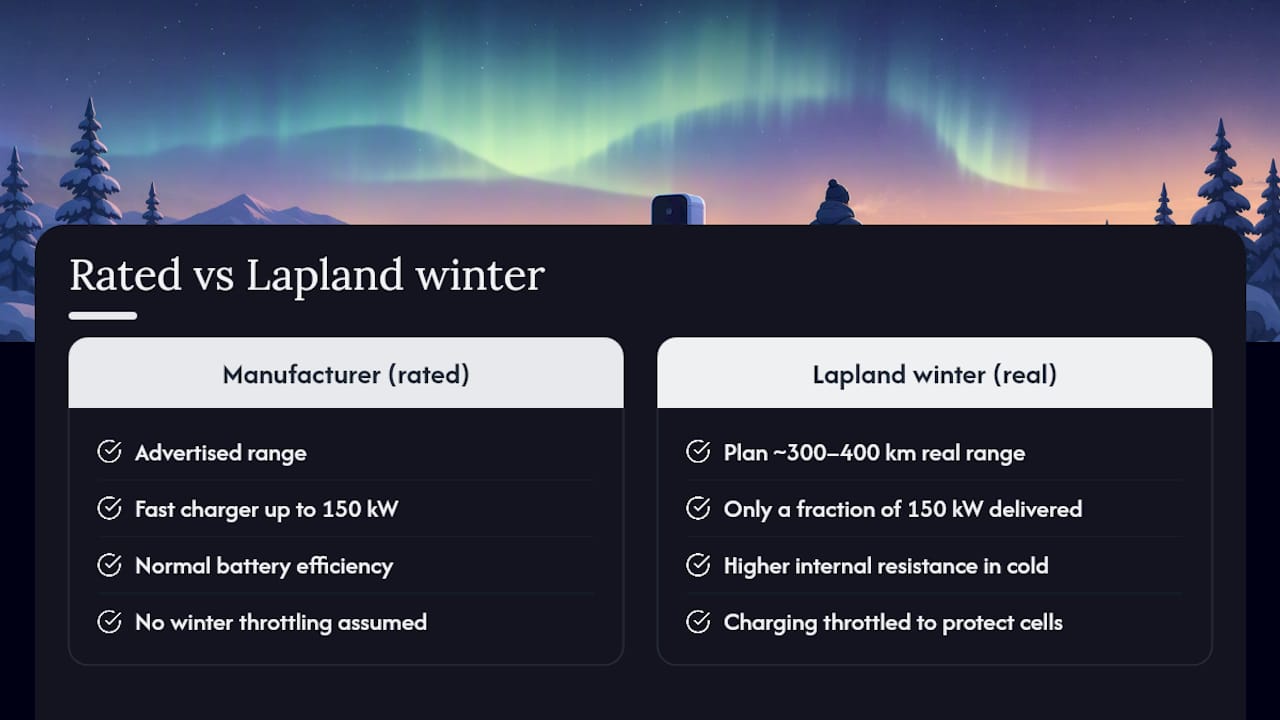
Battery chemistry simply works less efficiently in the cold. Internal resistance rises, which slows down the chemical reactions that deliver power to the motor and accept power during charging. That’s why manufacturers and Arctic charging specialists increasingly build winterproofed charging installations designed specifically for extreme cold, rather than assuming standard equipment holds up the same way it does in milder climates.
For your trip, that translates into two practical effects. First, your real-world range drops noticeably below the manufacturer’s rated figure once temperatures fall well below freezing, which is exactly why planning around 300–400 km rather than your car’s full advertised range matters so much in this region. Second, a fast charger that would normally deliver 150 kW might only deliver a fraction of that to a cold battery, because the battery’s own management system throttles charging speed to protect the cells.
Preconditioning solves most of this. Warming your battery while you’re still driving toward a charger, a feature most modern EVs support through the navigation system, lets the battery accept a faster charge the moment you plug in. Skip that step in deep winter and you might sit at a charger twice as long as you expected.
Sustainable travel meets practical EV planning
Lapland rewards travelers who plan ahead, and that’s true whether you’re booking a stay or mapping a charging route. Sunday Morning’s eco-luxury lodging and experiences, including our electric snowmobile safari, pair naturally with EV travel. A little planning turns a comfortable stay and a smooth drive into one seamless trip. If you have charging questions before booking, reach out. We’re happy to help you plan.
— Juho
Charging an EV in Lapland works reliably when you plan routes with real range margins and confirm charger status before each remote leg.
| Point | Details |
|---|---|
| Use multiple map tools | Cross-check latauskartta.fi, ChargeFinder, and PlugShare before committing to a route. |
| Install apps early | Set up Plugit Cloud and other operator apps with payment methods while you still have solid signal. |
| Plan conservative range | Budget 300–400 km real-world range with a 20–30% reserve, especially in winter. |
| Confirm hotel chargers | Ask about kW, fees, and app requirements before booking a stay that depends on overnight charging. |
| Always have a backup charger | Never treat one station as your only option on a remote leg between towns. |
Ready to pair your Arctic drive with a stay that matches the effort you put into planning it? Explore luxury accommodation in Lapland and book a sustainable base for your next Lapland trip.
Sources
- Sähköautoilu Lapissa - Neve
- Lapland, Finland EV Charging Stations | PlugShare
- Näin sähköautot toimivat Lapissa – ”En ole ainakaan vielä pettynyt”, sanoo Tuomas Lappalainen | Yle
- Lapland fast charging announcement
