


Keskiyön aurinko, Finland’s midnight sun, is the sun staying above the horizon through the night in far northern Lapland during summer months, with longest durations in the north such as Nuorgam and shorter periods as you move south, including places like Rovaniemi. We’ll walk through exact dates, the best spots to watch it, and how to actually enjoy a stretch of days without a real sunset.
TL;DR:
- The likelihood of seeing a reliable stretch of midnight sun increases significantly the farther north you go, with Nuorgam experiencing nearly two and a half months of continuous daylight.
- Atmospheric refraction causes visible midnight sun effects to occur slightly below the Arctic Circle, making southern towns like Rovaniemi experience shorter durations of the phenomenon.
- Optimal viewing spots include fell summits, lakes, and open coastlines, where unobstructed horizons allow for activities like midnight hiking, canoeing, and fishing without time restrictions.
- Planning for late evening hours, typically between 10 p.m. and 2 a.m., provides calmer conditions, softer light, and fewer insects for a better experience.
- Stay flexible with your schedule by packing layered clothing and using blackout methods, since your body may struggle to adapt to the continuous daylight.
Table of Contents
- Why does the sun never set in Lapland during summer?
- When and where to see it in Finnish Lapland
- Best places and activities for the midnight sun
- How to travel comfortably during the midnight sun
- Local culture and nature during the midnight sun
- A local’s take on watching the sun stay up all night
- Experience the midnight sun from a comfortable base in Pyhä
- Sources
Why does the sun never set in Lapland during summer?
Finland tilts toward the sun for months at a time, not just for a single dramatic sunrise. Earth’s axial tilt keeps the North Pole angled toward the sun through the northern summer, so anywhere above the Arctic Circle stays lit around the clock for weeks. That’s the mechanical answer, but the practical boundary in Finland sits a bit south of where you’d draw it on a globe.
Atmospheric refraction bends light around the curve of the planet, effectively lowering the horizon. Finland’s Wikipedia entry on keskiyön aurinko notes the real cutoff sits about one degree of latitude south of the theoretical Arctic Circle line near Kemi. That one degree matters if you’re deciding between destinations:
- The Arctic Circle crosses Finland just south of Rovaniemi, near Kemi.
- Refraction pushes visible midnight-sun effects slightly below that official line.
- Locations further north than Kemi get longer, more reliable stretches of continuous daylight.
- Southern Lapland towns see a shorter, more marginal version of the phenomenon.
When and where to see it in Finnish Lapland
Dates shift by a few days year to year, but the pattern holds: the farther north you go, the longer the sun stays up. Foreca’s Sääpedia tracks these windows town by town, and the spread between Finland’s northern tip and its Arctic Circle gateway is dramatic.
Nuorgam gets nearly two and a half months of unbroken daylight, more than double what Rovaniemi experiences, even though the two towns sit in the same country and roughly the same time zone.
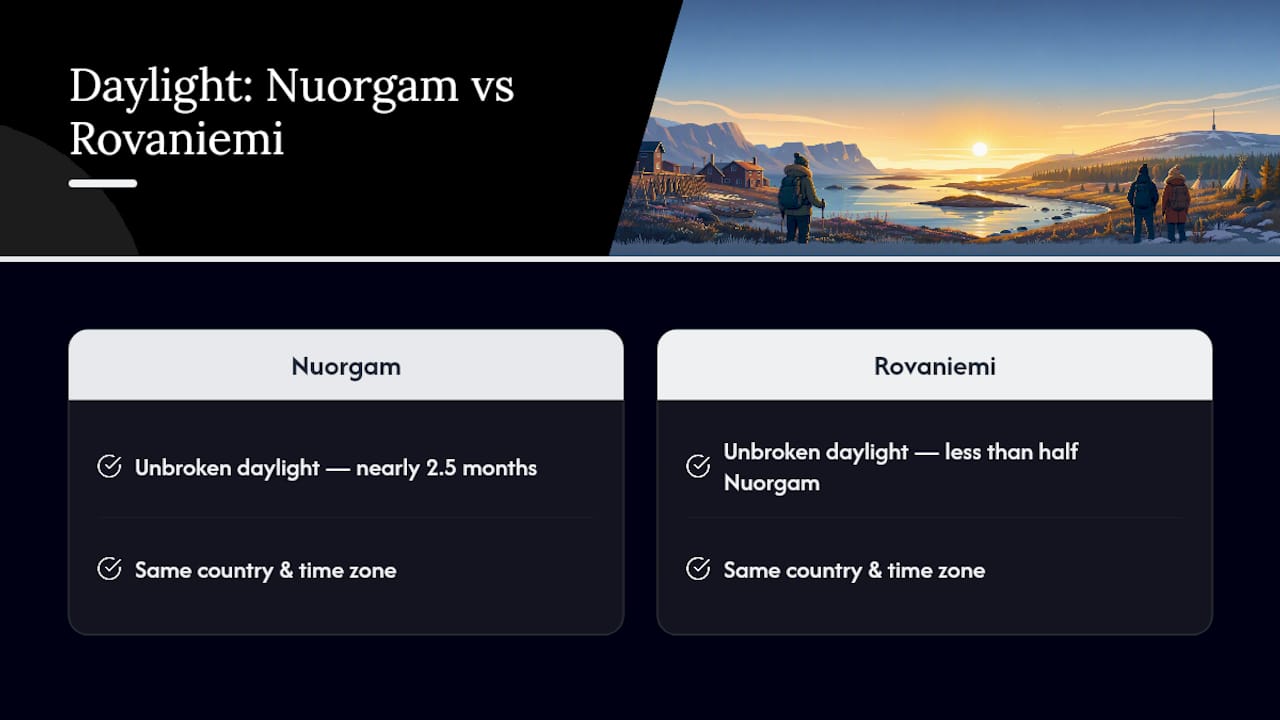
These dates move slightly from year to year, so treat the table as a planning guide rather than a fixed calendar. Local reporting from outlets like Koti-Lappi tracks the actual observed start dates each year in towns like Kemijärvi, Salla, and Savukoski, and it’s worth checking one of these sources close to your travel dates rather than relying on last year’s numbers alone.
Best places and activities for the midnight sun
Where you stand matters more than most visitors expect. A wide open horizon beats a scenic-but-hemmed-in valley every time, so scout your spot before the light gets good.
Fell summits, lakes, and river valleys each give a different version of the same phenomenon:
- Fell summits like Saana near Kilpisjärvi give you an unobstructed 360-degree horizon and often fewer insects once you’re above the treeline.
- Lakes such as Inarijärvi turn the low midnight light into long reflections across still water, which is where photographers tend to camp out.
- River valleys like the Teno near Utsjoki frame the sun against water and forest rather than open tundra, a softer look than a fell summit.
- Coastal islands and open shoreline work well too if you’re closer to the coast than the interior. Visit Nordic lists Utsjoki, Aavasaksa, and Rovaniemi as reliable bases for reaching these viewpoints.
Continuous daylight opens up activities that would be impossible almost anywhere else: midnight hiking, late canoeing, fishing at 2 a.m., even midnight golf at courses that stay open around the clock in June. Pick a spot with elevation or open water, and give yourself easy access late in the evening. Nobody wants to hike an hour back to the car at 1 a.m.
Pro Tip: Late evening, roughly between 10 p.m. and 2 a.m., often brings calmer wind, softer golden light, and fewer mosquitoes than the middle of the day. It’s the window locals actually plan around, not just tourists.
How to travel comfortably during the midnight sun
Round-the-clock daylight changes how your body and your schedule behave, so plan for that rather than fighting it.
- Pack layered clothing. Evenings cool off fast even in June, and weather can shift from sun to rain in an hour.
- Bring sun protection and insect repellent. UV exposure adds up over long daylight hours, and Lapland’s mosquitoes are famously persistent near water and marshland.
- Use an eye mask or blackout curtains. Most accommodations in Lapland stock these for exactly this reason, since your body still expects darkness even when the sky won’t give it to you.
- Choose durable, waterproof footwear. Trails can be muddy, and you’ll likely be out later and longer than you would at home.
- Watch the trail, not just the sky. It’s easy to lose track of time when the light never changes, so set a rough curfew for yourself on longer hikes.
Pro Tip: Shift your daily rhythm rather than resisting it. Eat dinner later, nap in the afternoon if you need to, and treat 11 p.m. like early evening instead of bedtime.
Local culture and nature during the midnight sun
Lapland treats the light as something to celebrate, not just endure. Midsummer bonfires and gatherings lean directly into the extended daylight, and many restaurants and tour operators shift their schedules to match, offering late dinners and midnight guided excursions rather than closing at sunset like everywhere else.
The natural world responds just as visibly:
- Plant growth accelerates fast enough to notice week to week during peak daylight.
- Wildlife activity often shifts, with animals active at hours that would be nighttime further south.
- Visit Rovaniemi frames the midnight sun as the direct opposite of kaamos, the winter polar night, when the same latitude gets weeks of near-total darkness instead.
- Keep noise down and stay on marked trails near breeding or nesting areas, since the extra daylight means more hours of visitor traffic through sensitive habitat.
A local’s take on watching the sun stay up all night
There’s a temptation to treat the midnight sun as a box to check, one photo at 1 a.m. and done. That undersells it. The real experience is spending a few unhurried days where your schedule loosens and you start doing things at hours that would feel strange anywhere else.
In Pyhä, a quiet fell walk around midnight, when the light turns gold and the trails empty out, tends to leave a stronger impression than any single sunset photo would. Pair it with a slow lakeside picnic the next evening, and you start to understand why locals don’t rush this season.
— Juho
Experience the midnight sun from a comfortable base in Pyhä
Chasing the midnight sun across multiple towns sounds appealing until you’re the one driving at 1 a.m. Sundaymorning gives you a fixed, comfortable base in Pyhä-Luosto National Park instead, so the light comes to you rather than the other way around.
The boutique Sunday Morning Resort and the modern Parkside Pyhä Apartments sit inside a national park, with private terraces where you can watch the late light without booking a tour or driving anywhere. Guided late-evening hikes and sustainable, locally sourced dining round out the stay, so you get the fell-summit views and the lakeside calm without the logistics. Check available dates and book your stay directly through Sundaymorning’s site to plan your midnight sun trip around your own schedule, not a tour bus timetable.
Sources
- Yötön yö, Foreca / Sääpedia
- Midnight sun — Visit Nordic
- Midnight sun — Visit Rovaniemi
- Keskiyön aurinko nousi Napapiirin pohjoispuolella — Koti-Lappi
