


TL;DR:
- Planning a low-impact luxury retreat in Lapland involves selecting a certified venue, sourcing local food, and actively managing waste. Focusing on these three areas and tracking a single KPI like waste diversion ensures effective environmental stewardship. Lapland’s unique landscape allows for memorable experiences rooted in local culture with minimal ecological impact.
You can run a luxury, low-impact retreat in Lapland by prioritizing three decisions up front: a venue with documented waste and energy systems, plant-forward local catering, and active waste and transport management. Get those three right, and most of your environmental footprint is addressed before guests arrive.
Your quick-start checklist:
- Ask every venue candidate for written proof of energy source, waste diversion rate, and composting infrastructure
- Brief your caterer on local seasonal sourcing and a plant-forward menu before signing any contract
- Set one measurable goal now, such as “divert 80% of event waste” or “source 100% catering within 100 miles”
- Confirm your waste hauler can actually process compostables before purchasing any compostable serviceware
- Assign a sustainability lead with a named role and a written checklist
TL;DR: Choose a certified venue, source food locally, staff your waste stations, and measure one KPI. That is the whole plan.
Table of Contents
- How do you plan an eco-friendly event step by step?
- What makes a venue truly sustainable — and how do you verify it?
- Which logistics choices reduce your event’s footprint the most?
- How do you get attendees to actually participate in your green event?
- How do you measure and report your event’s sustainability impact?
- How do you make your event regenerative, not just sustainable?
- Sundaymorning: your home base for a luxury regenerative Arctic retreat
- Key Takeaways
- Why Lapland is the right place for a regenerative luxury retreat
- Useful resources for planning your sustainable event
How do you plan an eco-friendly event step by step?
Begin 6–12 months out with venue selection and vendor vetting. Finalize sustainability systems 1–3 months before the event. Execute active management on-site. Report results within 2–6 weeks after.
Before the event (6–12 months out)
- Define one or two sustainability priorities. The UNDP recommends a stepwise approach — start with waste or paper reduction before expanding scope.
- Include a sustainability budget line item. Carbon footprint estimation, waste auditing, and data collection staff all cost money; build them in early.
- Send an RFP to venues with specific sustainability questions (see Section 3).
- Vet exhibitors and external partners against your materials and packaging policy.
- Offer hybrid attendance options for guests with high-emission travel distances.
During the event
- Staff waste stations at peak times; bins alone do not prevent contamination
- Run shuttle transfers from a central point to reduce individual car trips
- Keep water refill stations visible and clearly signed
- Brief your team each morning on waste sorting protocols
After the event
- Conduct a waste audit within 48 hours
- Run a travel survey and calculate per-attendee emissions
- Publish a short public sustainability summary within six weeks
- Share lessons learned with local partners and update your checklist for next time
Roles to assign: sustainability lead (owns KPIs), vendor liaison (contracts and compliance), volunteer waste monitors (peak-hour station staffing), local community liaison (partner relationships and cultural respect).
What makes a venue truly sustainable — and how do you verify it?
The venue is your single biggest sustainability lever. A certified property with documented systems does most of the heavy lifting; a beautiful space with no infrastructure leaves all the work to you.
Verification questions for your RFP and contract:
- What percentage of electricity comes from renewable sources?
- What is your current waste diversion rate, and how is it tracked?
- Do you have on-site composting, and which waste hauler processes it?
- Can you provide supplier provenance documentation for food and materials?
- Will you sign a contract clause committing to specific waste diversion targets?
Certifications to look for: LEED (over 60,000 LEED-certified buildings in the U.S.), ISO 14001, the Sustainable Travel Finland Label, and GSTC-recognized certifications. A 2024 Venue Sustainalytics analysis found 86% of certified venues actively track waste data, compared to near-zero for non-certified properties. That gap alone justifies making certification a non-negotiable requirement, not a nice-to-have.
Contract language to require: no single-use plastics, a local sourcing preference for catering, written proof of waste hauler capacity for compostables, and a post-event impact report.

Pro Tip: Require the venue to name its waste hauler and confirm in writing that the hauler processes compostables. Without that confirmation, compostable serviceware often ends up in landfill despite its higher cost.
Which logistics choices reduce your event’s footprint the most?
Transportation, catering sourcing, and active waste management move the needle most. Fix these three and you have addressed the majority of your event’s impact.
Transportation
- Organize centralized group transfers from the nearest airport or rail hub
- Offer a small incentive (priority check-in, a welcome gift) for guests who choose low-carbon travel
- For events with significant travel distances, add a virtual or hybrid segment to reduce total attendee flights
Catering
A plant-forward, locally sourced menu cuts both emissions and supply-chain complexity. Ask your caterer:
- What percentage of ingredients come from within 100 miles?
- How do you handle portion control and surplus food?
- Do you have a food-rescue partnership for leftovers?
For practical operator guidance on building a sustainable food service program, the Wild Foodz operator guide is a useful reference. Understanding the full picture of local sourcing benefits and trade-offs also helps when briefing caterers on procurement priorities.
Materials and waste
The 4Rs framework (refuse, reduce, reuse, recycle) is the standard starting point. In practice:
- Go digital-first for all communications, signage, and programs
- Use rented or reusable decor; ban single-use exhibitor freebies in your vendor guidelines
- Place three-stream waste stations (landfill, recycling, compost) at every high-traffic point
- Staff waste stations actively during peak hours — contamination rates drop significantly with a trained monitor present
How do you get attendees to actually participate in your green event?
Clear, early communication of your goals and simple on-site nudges increase attendee participation and can shift behavior beyond the event itself. Share the why — concrete community benefits turn compliance into genuine engagement.
Pre-event messaging priorities:
- A single-paragraph sustainability rationale in your registration confirmation
- Travel options with a low-carbon incentive clearly stated
- A short packing tip (reusable water bottle, no single-use toiletries)
On-site nudges that work:
- Waste station signs with pictures, not just words
- A welcome talk line: “Every meal tonight comes from within 50 miles of where we’re standing.”
- A short local-food tasting with a producer present — it doubles as education and creates a memorable moment
Metrics to track: share of guests using group transfers, waste diversion rate, and a one-question post-event survey on satisfaction with sustainable options.
Pro Tip: Frame sustainability as a local story, not a global obligation. Guests respond far better to “you’re supporting a Sámi reindeer herder tonight” than to a carbon statistic.
How do you measure and report your event’s sustainability impact?
Measure a few meaningful KPIs, report them publicly, and use the results to improve next time. You do not need a complex system — a simple data table and an honest summary are enough.
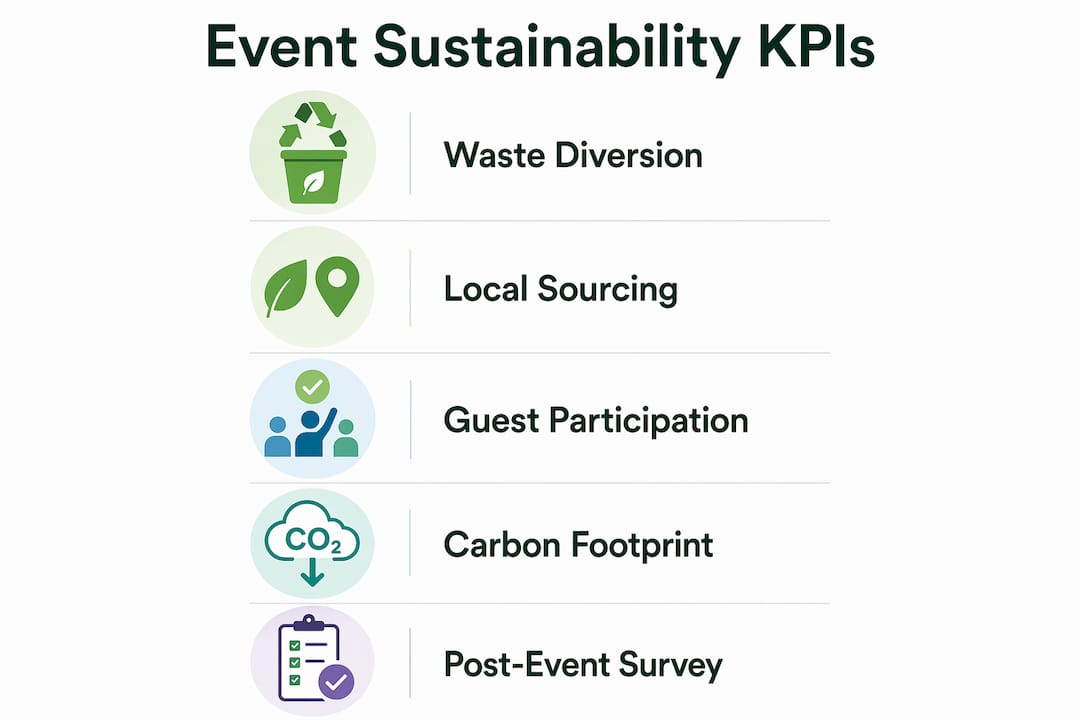
| KPI | Definition | How to measure |
|---|---|---|
| Waste diversion rate | % of waste diverted from landfill | Post-event waste audit |
| Per-attendee travel emissions | Estimated kg CO₂ per guest | Travel survey + emissions calculator |
| Local catering sourcing | % of food from within 100 miles | Catering invoices and provenance docs |
| Energy use | kWh consumed during event | Venue meter readings |
Recommended reporting outline: executive summary (one page), methods, results against targets, lessons learned.
Useful standards: the Events Industry Council’s sustainability resources and the APEX/ASTM Environmentally Sustainable Event Standards provide recognized frameworks for footprint calculation and reporting. GRI standards apply for organizations reporting at a corporate level.
Budget for measurement: include a line item for waste audit labor, a travel survey tool, and a half-day of data compilation. These costs are modest relative to total event spend and give you credible numbers to share with sponsors.
How do you make your event regenerative, not just sustainable?
Regenerative events actively improve the local environment and community rather than simply reducing harm. The shift is practical: center local hiring, supplier development, and one project that leaves something behind.
Partnership checklist for Lapland retreats:
- Hire local guides, drivers, and catering staff before looking outside the region
- Source ingredients from named local producers with fair-price contracts
- Invite a cultural custodian or indigenous guide to co-design any nature or cultural activity
- Include a revenue-share or capacity-building clause in supplier agreements
Practical regenerative actions in Lapland:
- Commission a local chef to develop a menu around traditional Arctic ingredients
- Include a guided cultural exchange with a reindeer herder — with their full consent and fair compensation
- Contribute to a habitat restoration project (fell trail maintenance, wetland care) as a group activity
- Donate surplus food to a local community program
Cultural sensitivity is non-negotiable. Obtain explicit consent for any cultural activity, protect sacred or sensitive sites, and pay fairly. A line item labeled “community benefit” in your budget — even a small one — signals genuine commitment to local partners.
Pro Tip: Ask your local guide what the community actually needs, not what looks good in a retreat brochure. The answer is usually simpler and more useful than you expect.
Sundaymorning: your home base for a luxury regenerative Arctic retreat
Sundaymorning provides luxury accommodation in Finnish Lapland aligned with the Sustainable Travel Finland Label — the criteria this guide is built around. The boutique Sunday Morning Resort and Parkside Pyhä Apartments sit inside Pyhä-Luosto National Park, giving your group immediate access to wilderness without a long transfer.

Every element of the retreat experience — Arctic activities, gourmet Lappish dining, guided nature excursions, and sauna — is curated with local sourcing and responsible tourism in mind. The responsibility commitments are publicly documented, so you can include them in your post-event sustainability report without extra research. Group and corporate retreat packages are available for direct booking, with the team ready to tailor an itinerary to your sustainability goals. Check availability and start planning your retreat at sundaymorning.fi.
Key Takeaways
Arranging an eco-friendly event comes down to three verified choices — certified venue, locally sourced catering, and staffed waste systems — plus one measurable KPI tracked from start to finish.
| Point | Details |
|---|---|
| Start with one or two priorities | Focus on waste or catering first; expand scope once you have a measurable win. |
| Certify your venue | Certified venues are far more likely to track waste data and deliver on sustainability promises. |
| Staff your waste stations | Active monitoring during peak hours is the standard for achieving real diversion rates. |
| Measure and report publicly | Track waste diversion rate, per-attendee emissions, and local sourcing percentage at minimum. |
| Book with Sundaymorning | Sundaymorning’s Lapland retreats are aligned with Sustainable Travel Finland standards and ready for group bookings. |
Why Lapland is the right place for a regenerative luxury retreat
Lapland works for regenerative retreats in a way that most destinations simply cannot replicate. The scale is small, the local culture is intact, and the wilderness is immediate. Those three conditions make it possible to design an event where the place itself is part of the program, not just a backdrop.
The lesson that shapes how Sundaymorning approaches group retreats is straightforward: the most memorable moments are almost always the ones tied to something genuinely local. A meal built around ingredients a guest has never encountered, a walk guided by someone who grew up in these forests, a sauna session followed by silence and snow. None of that requires a large footprint. It requires care in how you source, who you hire, and how you listen to the community you are visiting.
If you are planning a luxury retreat and want a partner who has already done the sustainability groundwork, the Sundaymorning team is a good place to start. Reach out through the meetings and events page to request a bespoke retreat plan.
Useful resources for planning your sustainable event
- Stanford OSEP Sustainable Event Planning Guide: Practical waste station staffing standards and active monitoring protocols.
- UNDP Sustainable Event Guidelines: Stepwise planning framework; ideal for first-time green event organizers.
- ICLEI Sustainable Event Guidelines: The 4Rs waste philosophy and operational checklists.
- ITA Group Eco-Friendly Events Guide: Attendee engagement tactics, transportation incentives, and recycling station setup.
- Events Industry Council: APEX/ASTM Environmentally Sustainable Event Standards for footprint calculation and reporting.
- ESGmark Sustainable Events Guide: Includes a venue survey template and practical ESG alignment steps.
- Sundaymorning Responsibility Page: Certification details and sustainability commitments for group retreat planning.
Recommended
- Why host events in Lapland for unique luxury success | Sunday Morning Collection
- Top 5 types of Arctic accommodations for luxury stays | Sunday Morning Collection
- Sustainable Lapland Travel, Done Beautifully | Sunday Morning Collection
- Lapland experiential travel guide 2026: eco luxury Arctic | Sunday Morning Collection
