


Sustainability certifications verify that a property has met independently audited environmental, social, and management standards — turning operational commitments into concrete guest guarantees. When you book a certified stay, you are not relying on a hotel’s own marketing copy. You are relying on a third-party auditor’s documented findings. For luxury Arctic travel, that distinction shapes everything from the food on your plate to the trails you walk.
The immediate benefits you can expect from a certified property:
- Verified environmental action: documented reductions in energy use, waste, and water consumption
- Worker welfare: audited labor standards covering staff conditions and fair pay
- Supply-chain transparency: traceable local sourcing for dining and activities
- Measurable guest guarantees: specific practices you can ask about and confirm
Three credibility signals worth knowing from the start: the GSTC (Global Sustainable Tourism Council) sets the international baseline criteria most reputable tourism certifications align with; Sustainable Travel Finland is the national label that verifies Finnish hospitality operators against those criteria; and ISSB disclosure frameworks are increasingly shaping how properties report their sustainability data to the public.
Table of Contents
- What does a sustainability certification actually mean?
- Why do certifications matter when booking luxury stays in Lapland?
- What certifications will you actually see on hotel pages?
- How can you verify a certification before booking?
- What are the limits and greenwashing risks?
- Why does alignment with global reporting frameworks matter?
- How does certification translate into your stay at Sundaymorning?
- Key Takeaways
- Why Sundaymorning invests in certification
- Certified sustainable luxury in Lapland, ready to book
- Useful sources and further reading
What does a sustainability certification actually mean?
A sustainability certification is an independent, third-party attestation that a property or supplier meets predefined environmental, social, or management criteria. It is worth separating three related terms that often get blurred:
- Standard: the rulebook — the specific criteria a property must meet
- Certification: the third-party confirmation that those criteria have been met, issued after an audit
- Label: the consumer-facing mark (the badge on a website or door) that signals certification
Who issues and governs these? Standard-setters write the criteria. Accredited certification bodies conduct the audits. Governance organizations like GSTC and iSEAL set the credibility principles — impartiality, transparency, and genuine stakeholder engagement — that separate credible certification schemes from hollow ones.
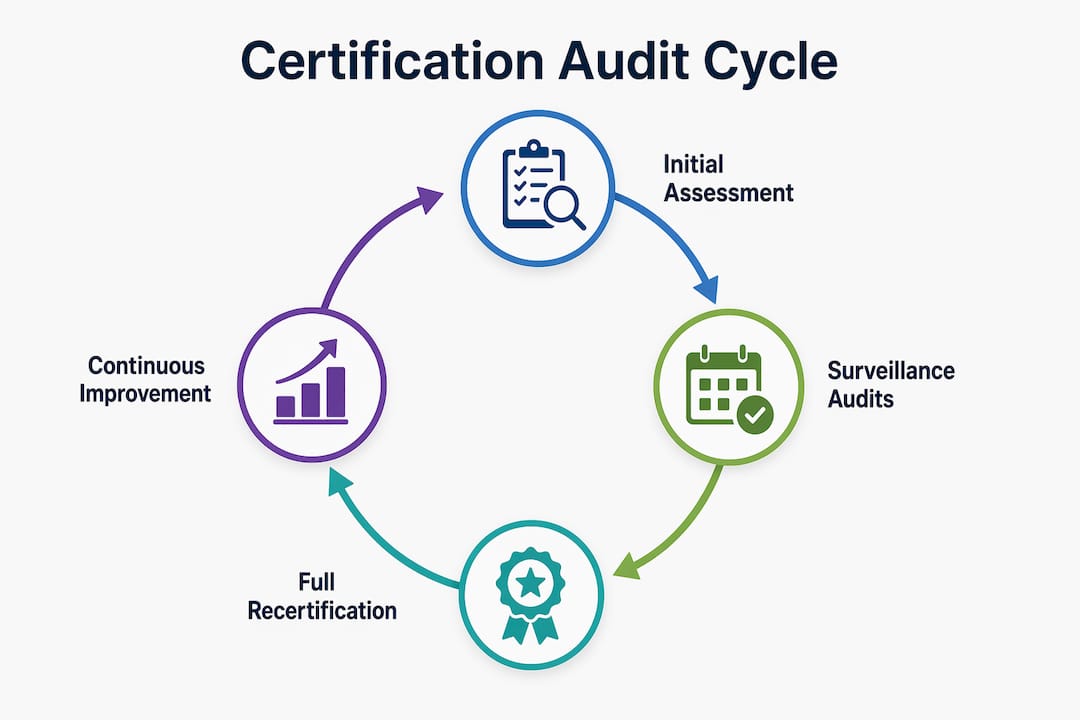
Audit cycles typically follow a structured path: an initial assessment, periodic surveillance audits, and a full recertification at defined intervals (often every one to three years). That cycle is what keeps a certification meaningful over time.

Why do certifications matter when booking luxury stays in Lapland?
Certifications matter because they give you measurable assurances about what you will actually experience and support. A lower carbon footprint, authentic local sourcing, and genuine community investment are not promises — they are documented outcomes tied to the property’s operating practices.
For a luxury Arctic stay, the guest-facing benefits are specific:
- Healthier indoor environments: certified properties typically document ventilation, material, and cleaning standards
- Consistent sustainable practices: dining, guided activities, and transport are all covered under the certification scope, not just the rooms
- Traceable local sourcing: high-end cuisine at certified properties can reference verified provenance, not just a vague “local” claim
- Community investment: conservation contributions that protect the very landscape you traveled to see
Operationally, certification signals management systems that reduce supply interruptions and maintain consistent quality — relevant when you are curating a once-a-year Arctic experience. Research shows that 83% of studies found operational benefits from adopting sustainability standards, and 73% cited sales and marketing benefits.
Pro Tip: For luxury Arctic stays, prioritize certifications that document food provenance, energy and waste practices, and nature-conservation commitments specifically — not just a general “eco-friendly” label with no scope.
What certifications will you actually see on hotel pages?
The major schemes you will encounter each verify something different. Here is a practical overview:
| Certification | Scope | What it verifies | Audit type | Recertification |
|---|---|---|---|---|
| GSTC criteria | Framework / baseline | Environmental, social, management | Third-party aligned | Varies by scheme |
| Sustainable Travel Finland | Property / company | Environmental, community, culture | Third-party audit | Annual review |
| EarthCheck | Property / company | Environmental performance benchmarks | Third-party audit | Annual |
| Green Globe | Property / supply chain | Environmental and social criteria | Third-party audit | Annual |
| LEED | Building | Energy efficiency, materials, indoor quality | Third-party audit | Ongoing |
| B Corp | Company | Governance, workers, community, environment | Third-party assessment | Every 3 years |
More than 450 sustainability labels are listed on the Ecolabel Index, with academic reviews estimating 300–500 voluntary sustainability standards globally. That proliferation is exactly why scrutiny matters. Only an estimated 15–20% of standards have sufficient market recognition to reliably transmit a consumer price premium above 10%.
One practical note for remote Arctic operations: regions without local accredited certification bodies can face 35–50% higher certification costs due to international auditor travel. Properties that have absorbed those costs and still pursued certification are signaling genuine commitment. Always cross-check brand claims with a published scorecard or audit date — not just the badge on the homepage.
How can you verify a certification before booking?
A few minutes of checking before you book can tell you whether a badge is real or decorative. Work through these seven questions:
- Is there a named third-party auditor? The certification body should be identifiable — not just “independently verified.”
- What is the scope? Does it cover the whole property, or only certain operations (e.g., the building but not the restaurant)?
- When was the last audit or recertification? A badge from five years ago with no renewal is a warning sign.
- Is there a public scorecard or report? A linked PDF, dashboard, or accreditation body listing counts as sufficient proof.
- What are the guest-facing guarantees? Ask what is specifically different about your stay because of the certification.
- Does it cover the supply chain? For a luxury culinary experience, you want food sourcing and activity providers included.
- Does it align with GSTC criteria or ISSB frameworks? Alignment with recognized international frameworks adds a layer of independent credibility.
When speaking with reservations, ask directly: “Can you share the auditor’s report or your most recent sustainability scorecard?” A property with genuine certification will have this ready. Vague answers or redirects to a general “sustainability page” with no linked documentation are a signal to probe further.
Pro Tip: Request a short guest-focused sustainability brief when booking high-end experiences. A credible property will send you a one-page summary of their certified practices — sourcing, energy, waste, and conservation — without hesitation.
What are the limits and greenwashing risks?
Not all badges guarantee meaningful action. Some certifications are self-declared, cover only a single metric, or operate with inconsistent governance. Knowing the red flags protects you from paying a premium for a hollow promise.
Watch for these warning signs:
- No auditor named anywhere on the property’s site
- No public scorecard, report, or accreditation body listing
- Vague language like “sustainable practices” with no defined scope
- One-off or marketing-only claims with no audit cycle documented
- Certifications with no stakeholder engagement or transparency requirements
The sheer volume of labels makes this harder than it sounds. With more than 450 listings on the Ecolabel Index and academic reviews estimating 300–500 voluntary sustainability standards globally, the market is crowded with schemes of wildly varying rigor. Academic research identifies five primary motivations for adopting voluntary sustainability standards: reputational risk mitigation, price premium, market access, innovation, and values-driven adoption. When a property’s motivation is purely reputational, the certification often reflects that — process compliance on paper, not genuine operational change.
Key insight: Certifications used as one-off PR wins, or those with low bars, dilute long-term value and introduce real risk for travelers who have paid for an authentic experience.
Certifications also have practical limits in remote Arctic settings. They may not cover every activity provider or transport partner — important when your itinerary includes guided snowmobile routes or reindeer farm visits that involve third-party operators.
Why does alignment with global reporting frameworks matter?
Certifications aligned with recognized frameworks and regulatory trajectories are more durable — and give you stronger assurance that a property’s commitments will hold over time, not just through the current marketing season.
The EU Carbon Border Adjustment Mechanism (CBAM) entered its transitional phase in October 2023 and becomes fully operational in 2026, increasing demand for verified emissions reporting across supply chains. ISSB disclosure frameworks rely on verified measurement, reporting, and verification (MRV) data — the same kind of data that strong sustainability certifications already require properties to collect. Satellite-based MRV has reduced verification costs for certain environmental claims by 60–80% while improving accuracy from roughly 70% to over 95% in some land-use monitoring contexts.
The practical takeaway: prioritize properties that reference alignment with GSTC criteria, ISSB frameworks, or national accreditation bodies. These are the certifications built to last, not just to look good on a booking page today.
How does certification translate into your stay at Sundaymorning?
Sundaymorning holds the Sustainable Travel Finland label — a third-party audited certification that maps directly to the trust signals you should be looking for. That label is not a marketing badge. It reflects documented operational practices across the property, dining, and activities.
Specific guest-facing guarantees tied to the label include:
- Sourcing transparency: local and seasonal ingredients at Restaurant Aihki are traceable, with provenance documented as part of the certification scope
- Conservation-aware activity design: guided Arctic experiences are structured to minimize trail impact and support the Pyhä-Luosto National Park environment guests come to enjoy
- Energy and waste practices: measured reductions in energy use and waste, consistent with what certified green building and energy programs typically deliver
- Staff welfare policies: audited labor standards covering the team behind your experience
On Sundaymorning’s Responsibility page, you can find the specifics: certification scope, documented practices, and links to further detail. When booking, ask reservations for a short sustainability brief — Sundaymorning’s team can walk you through exactly what the Sustainable Travel Finland label covers for your stay.
Pro Tip: When booking a high-end experience at Sundaymorning, ask: “Can you send me a one-page summary of what your Sustainable Travel Finland certification covers for guests?” It takes two minutes and gives you complete confidence before you arrive.
Key Takeaways
Third-party audited certifications that publish scorecards and align with recognized frameworks like GSTC give you the most reliable assurance of genuine sustainable practices at a luxury stay.
| Point | Details |
|---|---|
| Third-party audit is non-negotiable | Always confirm a named auditor and a recent audit date before trusting a sustainability badge. |
| Public scorecard = real proof | A linked report or accreditation listing is the minimum standard for credible certification. |
| Guest-facing guarantees matter most | Ask specifically what is different about your stay: sourcing, energy, conservation, staff welfare. |
| Framework alignment adds durability | Certifications aligned with GSTC criteria or ISSB frameworks are built to hold up as regulations tighten. |
| Sundaymorning’s STF label | Sundaymorning holds the Sustainable Travel Finland label, with documented practices across dining, activities, and accommodation. |
Why Sundaymorning invests in certification
Certification at Sundaymorning exists for one reason: to protect the place guests come for and to guarantee that the hospitality they receive is genuinely what it claims to be. The Pyhä-Luosto landscape is the product. If the trails are degraded, the wildlife disturbed, or the local food culture hollowed out by shortcuts, the experience disappears.
One concrete change driven by the Sustainable Travel Finland certification process: the seasonal sourcing protocol at Aihki restaurant. The certification required documenting supplier provenance and building a structured seasonal menu framework — not just claiming “local ingredients” but verifying and recording them. That process changed how the kitchen plans, sources, and communicates with guests.
If you want to know exactly what our certification covers for your stay, ask when you book. We are happy to send you a brief.
Certified sustainable luxury in Lapland, ready to book
If you want a property where the sustainability claims are backed by an independent audit, Sundaymorning is a straightforward answer. The Sustainable Travel Finland label covers the full guest experience: the accommodation, the local culinary sourcing at Aihki, and the curated Arctic activities designed around Pyhä-Luosto National Park.

Certified experiences available include aurora-terrace stays with Northern Lights viewing, private tasting menus built on verified seasonal sourcing, and conservation-aware guided activities from husky safaris to snowshoeing. Every element connects back to the same audited standard.
Browse luxury accommodation in Lapland at Sundaymorning, or check the Arctic Winter Getaway Package for a curated certified stay. When you book, request the property’s sustainability brief — the team will send it before you arrive.
Useful sources and further reading
- ISEAL Alliance: Evidence on operational and business benefits of adopting sustainability standards, including the 83% operational benefit finding cited above.
- Sustainability Atlas: Practical explainer on standards, certifications, recognition rates, cost factors, and MRV advances — source for the 15–20% premium recognition figure and the 35–50% cost differential.
- Trellis: Guidance on navigating the crowded certification market, including the 450+ Ecolabel Index figure and governance credibility principles.
- EcoVadis Glossary: Overview of sustainability certification types and energy/cost reduction benchmarks for certified green programs.
- MDPI Voluntary Sustainability Standards: Academic review of VSS adoption motivations — reputational risk, price premium, market access, innovation, and values-driven adoption.
- Sundaymorning Responsibility page: Brand sustainability policies, certification scope, and documented practices.
- Sustainable Travel Finland label explainer: How the label is earned and what criteria Sundaymorning met — primary EEAT source for brand claims in this article.
Recommended
- Cozy Lapland getaways: luxury, sustainability & Arctic experiences | Sunday Morning Collection
- Sustainable Lapland Travel, Done Beautifully | Sunday Morning Collection
- What is Nordic luxury? Sustainable Arctic elegance guide | Sunday Morning Collection
- Luxury family adventures in Lapland: Complete guide | Sunday Morning Collection
