


TL;DR:
- Sustainable resorts in Lapland prioritize local sourcing, renewable energy, and community integration.
- Eco-luxury experiences offer authenticity, cultural connection, and environmental benefits without sacrificing comfort.
- Verify sustainability claims through independent certifications and specific performance data to avoid greenwashing.
Luxury in Finnish Lapland is quietly being redefined. The most exclusive escapes here are no longer about marble lobbies or imported amenities. They are about waking up to fresh Arctic air, eating reindeer raised by local herders, and knowing your stay actively protects the wilderness around you. Sustainable resorts in Lapland are challenging the old idea that eco-friendly means roughing it. In fact, the opposite is true. These properties often deliver a richer, more personal, and more memorable experience than any conventional five-star hotel. This guide walks you through everything you need to know to choose wisely and travel with real purpose.
Table of Contents
- What makes a resort truly sustainable in Lapland?
- Luxury without compromise: Guest experience and eco benefits
- Culinary excellence and Lapland’s local impact
- Transparency, trust, and the challenge of greenwashing
- A fresh take: Beyond the badges — What truly defines an eco-luxury stay?
- Ready for your authentic sustainable Lapland escape?
- Frequently asked questions
Key Takeaways
| Point | Details |
|---|---|
| Eco-luxury redefined | Sustainable resorts in Lapland deliver both comfort and authentic experiences for high-end travelers. |
| Certifications matter | Look for Green Key, STF, and other credible labels—but also seek transparency and real impact. |
| Genuine local benefit | Choosing resorts sourcing locally boosts Lapland’s communities and enhances your cultural immersion. |
| Question greenwashing | EU rules and prevalence of vague claims mean travelers should ask for specifics, not just badges. |
What makes a resort truly sustainable in Lapland?
With the promise of eco-luxury in mind, let’s clarify what true sustainability looks like in the unique context of Lapland’s most refined accommodations.
Sustainability in the Lapland hospitality world goes well beyond recycling bins and low-energy bulbs. It covers how a resort sources its food, heats its cabins, manages its waste, and pays its staff. The best properties weave these values into every corner of the guest experience, making responsible choices feel natural and even pleasurable.
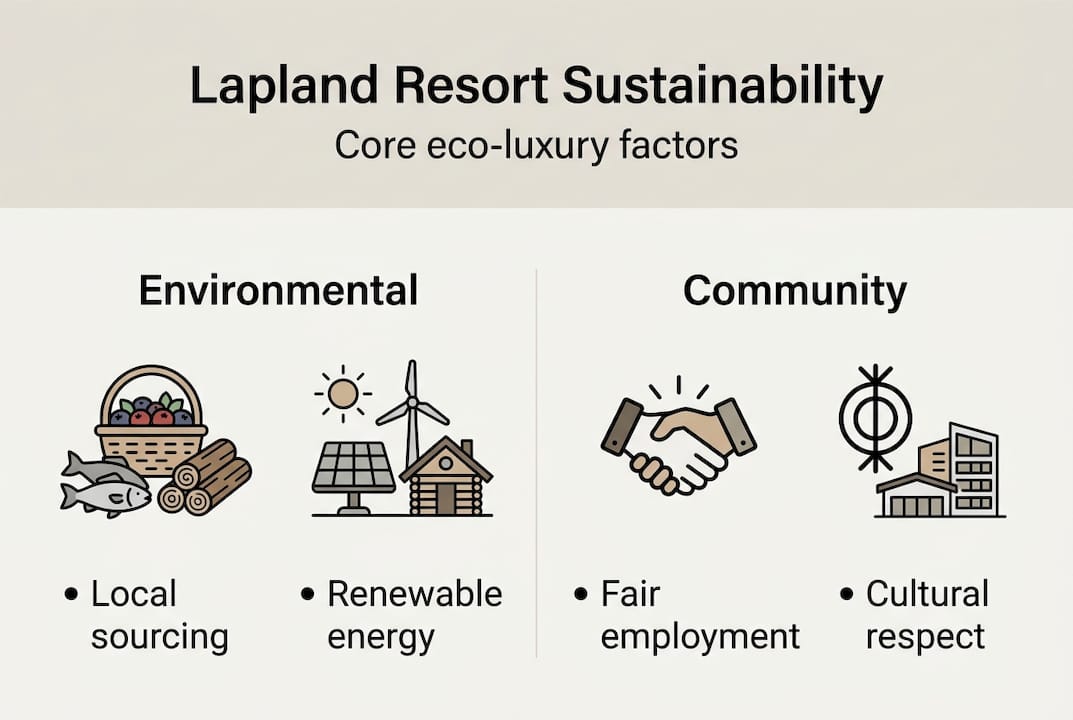
Three certifications carry the most weight in Finnish Lapland. Certifications like Green Key, Sustainable Travel Finland, and EcoCompass verify that a resort has passed independent audits covering energy use, water management, waste reduction, and community contribution. These are not self-awarded badges. They require documented evidence and regular review.
Here is a snapshot of how leading Lapland resorts compare:
| Resort type | Common certifications | Key eco-feature |
|---|---|---|
| Boutique wilderness lodge | Sustainable Travel Finland | 100% renewable heating, local food sourcing |
| National park resort | Green Key | Minimized light pollution, wildlife protection |
| Eco-cabin retreat | EcoCompass | Zero single-use plastics, composting program |
| Luxury forest resort | Green Key + STF | Carbon tracking, community employment focus |
The hallmarks that matter most for eco-conscious travelers include:
- Renewable energy use: Solar, geothermal, or biomass heating is standard in genuine resorts
- Local sourcing: Food, materials, and services sourced within the region
- Waste reduction: Composting, refillable amenity systems, and zero single-use plastics
- Community integration: Partnerships with Sámi and Finnish local businesses
- Transparent reporting: Publicly shared environmental impact metrics
You can explore sustainable Lapland travel examples to see these values in action across different property types.
Pro Tip: Do not stop at the certification logo. Ask the resort for their most recent audit summary or energy consumption report. Genuine properties welcome this question. Those who hedge or deflect are worth a second look before you book. You can also use this guide on how to verify sustainability claims before committing.
Luxury without compromise: Guest experience and eco benefits
Understanding what defines sustainability, let’s explore how this shapes your luxury experience, going far beyond the basics.
The most common concern among first-time eco-lodge guests is simple: will I have to give up comfort? The answer, especially in Finnish Lapland, is a clear no. The region’s leading sustainable resorts have invested heavily in design, cuisine, and personalized service. Many exceed the comfort standards of conventional luxury hotels while offering something those hotels simply cannot replicate: an experience that feels genuinely connected to the place.
Here is a comparison of experiences exclusive to sustainable resorts versus standard luxury hotels:
| Experience | Sustainable Lapland resort | Standard luxury hotel |
|---|---|---|
| Wildlife immersion | Private eco-safari with trained naturalist | Packaged tour with large groups |
| Transport | Emission-free e-sled or reindeer safari | Snowmobile fleet, no emissions tracking |
| Food | 85%+ locally sourced, seasonal Arctic menu | International menu, imported ingredients |
| Cultural connection | Sámi storytelling, local artisan visits | Generic cultural performance |
| Environmental impact | Actively positive, measurable | Offset programs only |
Choosing a sustainable resort adds depth to your ethical travel story in several ways:
- You directly support Lapland’s local economy and Indigenous communities
- Your stay funds ongoing conservation of the national park ecosystem
- You access experiences that are off-limits to mass tourism
- Your footprint is lower, making the choice easier to feel proud of
- You return home with stories grounded in real cultural exchange, not curated performance
The research backs this up too. Sustainable practices enhance guest satisfaction, retention, and the quality of Arctic adventures. A study published on ResearchGate confirms significant effects on satisfaction and retention among guests who stay in environmentally responsible properties, with participants rating their overall experience higher than those in conventional accommodations.
Did you know? Guests at sustainable resorts report measurably higher satisfaction scores, particularly around authenticity, personal connection to nature, and overall trip value.
If you want to go deeper on what awaits you, explore Arctic eco-luxury adventures or browse the full range of types of eco-friendly accommodations available in the region.
Culinary excellence and Lapland’s local impact
Of course, beyond adventure and comfort, the table is where sustainability becomes deliciously tangible.
Some of the most memorable moments in a Lapland luxury stay happen around food. Think pan-seared Arctic char caught that morning, cloudberry preserve made from berries picked near the treeline, and fresh rye bread baked using a recipe passed down through generations. This is not just good dining. It is a form of cultural storytelling.

The best sustainable resorts source over 85% of their ingredients locally, reducing transport emissions while keeping money inside the Lapland economy. That figure is significant. Most conventional luxury hotels hover far below this benchmark, relying on centralized distribution systems.
The benefits ripple out in three directions:
For you as a traveler:
- Fresher, more flavorful ingredients at every meal
- Direct exposure to Arctic culinary traditions that few outsiders experience
- The satisfaction of knowing your dining choices support real families and small farms
For the Lapland community:
- Steady income for local farmers, foragers, and food producers
- Preservation of traditional knowledge and artisan crafts
- Stronger regional economy less dependent on outside capital
For the environment:
- Shorter supply chains mean fewer transport emissions
- Seasonal menus reduce waste and align with natural cycles
- Reduced packaging from local, bulk deliveries
Pro Tip: When researching resorts, ask specifically which farms or producers they partner with. A resort that can name its suppliers and explain those relationships is practicing genuine local sourcing, not just using it as a marketing phrase. You can read more about Arctic culinary traditions to understand what authentic Nordic cuisine looks like before you arrive.
The luxury sustainability stories from this region show that when resorts commit to local sourcing, the quality of the guest experience rises in parallel. The kitchen becomes one of the most compelling reasons to choose responsibly.
Transparency, trust, and the challenge of greenwashing
With culinary and cultural delights in mind, a deeper question remains: How do you ensure your resort walks the talk on sustainability amid changing regulations?
Greenwashing is real, and it has reached the travel industry in a meaningful way. Some properties use terms like “eco-friendly” or “green” without any meaningful practice behind them. For affluent travelers who care about genuine impact, this is frustrating and costly in more ways than one.
The European Union is tightening its grip on vague environmental claims. EU greenwashing rules ban vague claims like “environmentally friendly” or “carbon neutral” unless backed by verified data and independent certification. This applies directly to Finnish Lapland’s tourism sector, which has been under increasing scrutiny. Up to 40% of environmental claims in the travel space may be unfounded or misleading, making verification essential before you book.
Here are the key questions to ask when evaluating any Lapland resort:
- Which third-party body issued your certification, and when was it last renewed?
- Can you share your most recent energy and water consumption figures?
- What percentage of your food and supplies comes from within Lapland?
- How do you measure and report your carbon impact?
- What portion of your staff is locally hired?
You can also use this guide on questions to spot greenwashing to sharpen your approach before reaching out to properties.
A note worth holding onto: Some resorts argue that sustainable operations cost more and must charge premium rates. While there can be short-term investment costs, the long-term return in guest loyalty, repeat visits, and authentic reputation far outweighs the overhead. The real cost of greenwashing is trust, and that is much harder to recover.
When you find certified resorts in Lapland that are willing to answer these questions openly and specifically, that transparency itself tells you something important about who they are.
A fresh take: Beyond the badges — What truly defines an eco-luxury stay?
Certifications matter. They are a useful starting point and a meaningful signal of commitment. But after spending time in this region and talking with people who live and work here year-round, we have come to believe that the most genuinely sustainable stays are defined by something harder to quantify.
Some of the most impactful properties we know are small, family-run, and not yet certified. They use wood from their own forest, cook recipes their grandparents taught them, and hire neighbors. They cannot always afford the audit fees that major certification bodies charge. Yet their daily actions often outpace those of larger, badge-heavy competitors.
What you should look for beyond the logo is lived values. Does the staff talk about sustainability naturally, without a script? Does the resort feel embedded in its surroundings rather than imposed on them? Are the practices visible during your stay, not just listed in a brochure?
You can see what genuine sustainability looks like in practice before deciding where to invest your time and money. Ask questions when you arrive, not just before you book. Notice whether the answers match what you see around you.
Ready for your authentic sustainable Lapland escape?
If you are inspired to experience the real meaning of sustainable luxury in Lapland, the next step is simple.
At Sunday Morning Finland, we have built our approach around the values this article describes: local sourcing, genuine partnerships, transparent practices, and experiences that feel connected to the land. Whether you are drawn to the stillness of the national park, the warmth of a wood-fired sauna, or the thrill of a husky safari under the Northern Lights, we offer it all with intention.
Explore our luxury sustainable accommodation options within Pyhä-Luosto National Park, or take a closer look at our Arctic Winter Getaway package to see what a purposeful, comfortable, and truly memorable Lapland stay looks like from the first morning to the last.
Frequently asked questions
How can I tell if a Lapland resort is genuinely sustainable?
Check for third-party certifications like Green Key and ask for specific actions. Genuine resorts are transparent about their audits, energy metrics, and local sourcing percentages.
Do sustainable resorts in Lapland offer luxury experiences?
Yes. These resorts combine comfort, exclusivity, and unique Arctic adventures that often exceed standard luxury. Sustainable practices enhance guest satisfaction and enable distinctive experiences like emission-free safaris and private nature immersion.
What eco-certifications should I look for in Finnish Lapland?
Look for credible labels verified through independent audits. Certifications like Green Key and STF are the most recognized in Finnish Lapland and require documented, renewable compliance.
Does sustainable travel in Lapland cost more?
Up-front rates may be slightly higher, but studies show guests find the experience more rewarding, with stronger satisfaction and loyalty. The value delivered tends to justify and often exceed the investment.
Recommended
- Sustainable Lapland Travel, Done Beautifully | Sunday Morning Collection
- Cozy Lapland getaways: luxury, sustainability & Arctic experiences | Sunday Morning Collection
- Luxury Lapland Holiday Packages That Feel Easy | Sunday Morning Collection
- Luxury Accommodation in Lapland | Sunday Morning Collection
- Duurzame vakantiehuizen: betekenis, voordelen en tips
