


Villiruoka in Lapland means wild food gathered from Arctic forests and fells, then turned into guided foraging hikes, chef-led tasting dinners, and hands-on cookery courses. It suits food travelers, nature lovers, and anyone chasing a real taste of Finnish culture rather than a souvenir version of it. Book with the season in mind, and choose an operator who can explain exactly where your meal came from.
TL;DR:
- Wild food in Lapland is tailored to seasonal peaks, such as cloudberries from late July to August and reindeer meat available year-round but most abundant in autumn.
- Experiences range from guided foraging hikes and outdoor cookery to multi-course dinners, all emphasizing sustainability and local provenance.
- Proper preparation and safety measures, including allergen awareness and species identification, are essential, especially for self-guided foraging.
- Bookings should be transparent about ingredient sourcing, the seasonality of menu items, group sizes, and guide qualifications to ensure an authentic experience.
- Small-scale, personal encounters with foragers and chefs remain the most genuine and sustainable way to enjoy Lapland’s wild food landscape.
Table of Contents
- What villiruoka means in Lapland
- Key Lapland Ingredients and When to Find Them
- Types of Wild-Food Experiences You Can Book
- What to Expect on the Day
- How Lapland Sources Wild Food Responsibly
- Foraging and Food Safety Rules in Finland
- Choosing the Right Villiruoka Experience
- An Editor’s View on Small-Scale Wild-Food Experiences
- Book a Wild-Food Experience With Sunday Morning Collection
- Sources
What villiruoka means in Lapland
Villiruoka translates loosely to “wild food,” but in Lapland it carries more weight than the English phrase suggests. It describes an entire way of eating that grew out of necessity: Sámi and Finnish settler communities built their diets around what the fells, rivers, and forests actually produced, not what could be shipped in. That habit never disappeared. It became a selling point.
Lapland’s short growing season is the reason the food tastes the way it does. Intense summer light followed by a fast cooldown concentrates sugars and aromatic compounds in wild plants and berries, which is why a handful of Arctic cloudberries can taste sharper and more floral than cultivated fruit grown farther south. Chefs in the region lean into that intensity rather than diluting it.
Today, villiruoka shows up in three main forms:
- Multi-course dinners built around a single season’s harvest
- Guided foraging treks that end in a campfire meal
- Workshops where guests learn to identify, harvest, and cook wild ingredients themselves
Key Lapland Ingredients and When to Find Them
Knowing what’s in season helps you pick the right month for a trip, and it helps you recognize what’s actually on your plate during a wild-food dinner. Lapland’s pantry runs on a tight calendar, and most operators build their menus around whatever peaks that week.
Reindeer meat, Arctic fish, wild berries, and the local puikula potato are the ingredients most associated with the region, and several carry EU origin designations that back up provenance claims rather than just marketing language. Wild herbs like nettle and väinönputki are at their best early in the season, and foragers usually harvest them in the early morning, when the leaves are least stressed and least likely to carry insects.
| Ingredient | Peak season | Typical preparation |
|---|---|---|
| Cloudberry (hilla) | Late July to August | Fresh, jam, dessert sauce |
| Bilberry (mustikka) | July to September | Fresh, baked, dried for winter use |
| Wild herbs (nettle, väinönputki) | May to June | Fresh, blanched, frozen, or dried |
| Wild mushrooms | August to October | Sautéed, dried, infused into broths |
| Reindeer meat | Year-round, peak availability autumn | Smoked, sautéed, slow-cooked |
| Arctic char and whitefish | Summer through early autumn | Grilled, cured, smoked |
| Lapland puikula potato | September through winter storage | Roasted, mashed, paired with fish |
Pro Tip: If you’re visiting outside peak berry or herb season, ask your host how they preserve summer’s harvest. Freezing, drying, and infusing are standard techniques that let a Lapland kitchen serve wild flavors in the middle of winter.
Types of Wild-Food Experiences You Can Book
Villiruoka experiences in Lapland break into three formats, and each suits a different kind of traveler.
- Guided foraging treks with a campfire lunch. These typically run several hours and combine a walk through forest or fell terrain with hands-on harvesting, followed by a meal cooked outdoors. Most operators ask for booking some days in advance, and difficulty is usually moderate, suited to anyone comfortable walking on uneven ground.
- Wild-food dinners and tasting menus. Lodges and chalets across the region run multi-course dinners that showcase a chef’s interpretation of the season’s ingredients, often pairing each course with a short story about where the ingredient came from. These require less physical effort and work well for couples or groups who want the culture without the hike.
- Hands-on cookery courses and producer visits. Smaller groups learn direct from a chef or forager, covering identification, harvesting technique, and simple preparation. Group sizes tend to stay small, which keeps the experience personal rather than staged.
Prices vary by format and group size, so ask directly rather than assuming a flat rate. Booking early matters more than most travelers expect. Popular dinners and treks fill fast during peak berry and mushroom season, and some operators set a minimum group size before confirming a date, so check that detail before you lock in travel plans.
What to Expect on the Day
A well-run villiruoka experience should feel organized before it feels adventurous. Most treks and outdoor meals start at a set meeting point, often a lodge or activity hub, with transfers arranged for guests staying farther out. Dress for genuine Arctic conditions: layered clothing, waterproof boots, and a warm outer shell, even in summer, since forest floors stay damp and evenings cool fast.
Food safety in outdoor settings deserves attention. A reputable guide will:
- Confirm allergens before the trek or meal begins
- Handle raw fish and game separately from foraged plants
- Explain which species are safe to eat and which look similar but are not
Accessibility varies by activity. Foraging treks generally suit adults and older children with reasonable mobility, while lodge dinners accommodate nearly anyone. Guided formats consistently reduce the identification and allergen risks that come with foraging solo, which matters most for first-timers who can’t yet tell a safe mushroom from a dangerous look-alike.
Pro Tip: Ask whether the menu changes with what was foraged that morning. A kitchen willing to adjust dishes on short notice is usually the strongest sign you’re getting a genuinely seasonal experience, not a fixed script.
How Lapland Sources Wild Food Responsibly
Ethical sourcing isn’t an afterthought in Lapland’s food scene. It’s closer to the operating model. Connecting local foragers, reindeer herders, and fishermen directly to restaurants and tour operators keeps money in small communities and cuts down on food traveling long distances to reach a plate.
Applied research on Lapland’s food systems shows that using reindeer and fishery side streams in local menus supports both circularity and local economic value, turning what used to be waste into an ingredient with a story attached.
Good practice among serious operators includes:
- Harvesting berries and herbs within sustainable limits rather than stripping a patch bare
- Sourcing reindeer and fish from known, traceable local producers
- Rotating foraging locations to avoid overharvesting the same patch season after season
Visitor interest tends to track with how well an operator tells that story. Guidance for Lapland’s food-tourism sector suggests pairing local ingredients with clear provenance and narrative increases both engagement and repeat business, which explains why the best Lapland kitchens talk as much about their forager as their menu. You can read more about how sustainability shapes Lapland’s culinary tourism if you want the fuller picture.
Foraging and Food Safety Rules in Finland
Finland’s jokamiehenoikeudet, or everyman’s rights, allow anyone to pick wild berries, mushrooms, and most herbs on uncultivated land, including land you don’t own, without asking permission. That said, some species are protected, and picking rules can shift depending on whether land sits inside a national park, so it’s worth checking local signage or asking a guide before harvesting anything unfamiliar.
Practical safety matters just as much as legal clarity:
- Never eat a wild mushroom or plant you can’t identify with certainty
- Handle raw reindeer and fish separately from foraged greens to avoid cross-contamination
- Keep outdoor meals at safe temperatures, especially in summer’s brief warm spells
Guided experiences exist largely to remove the guesswork. A trained forager knows which look-alikes to avoid and which species are off-limits, and that knowledge is worth far more to a first-timer than a foraging app.
Choosing the Right Villiruoka Experience
A good villiruoka booking comes down to transparency. Before you commit, run through this checklist:
- Confirm the season matches the menu. A dinner promising fresh cloudberries in February should raise questions.
- Ask what’s foraged versus sourced. A transparent operator will tell you plainly which ingredients came from that morning’s trek and which came from a trusted local supplier.
- Check dietary flexibility. Wild-food menus can be harder to adapt than standard restaurant fare, so confirm allergen handling in advance.
- Ask about guide qualifications. Foraging guides should be able to explain their plant identification training, not just their enthusiasm.
- Review the cancellation policy and group size. Arctic weather changes fast, and a flexible policy protects your trip.
Watch for red flags: vague pricing, no mention of where ingredients come from, or no safety briefing before a foraging trek. Any of those should send you looking elsewhere.
An Editor’s View on Small-Scale Wild-Food Experiences
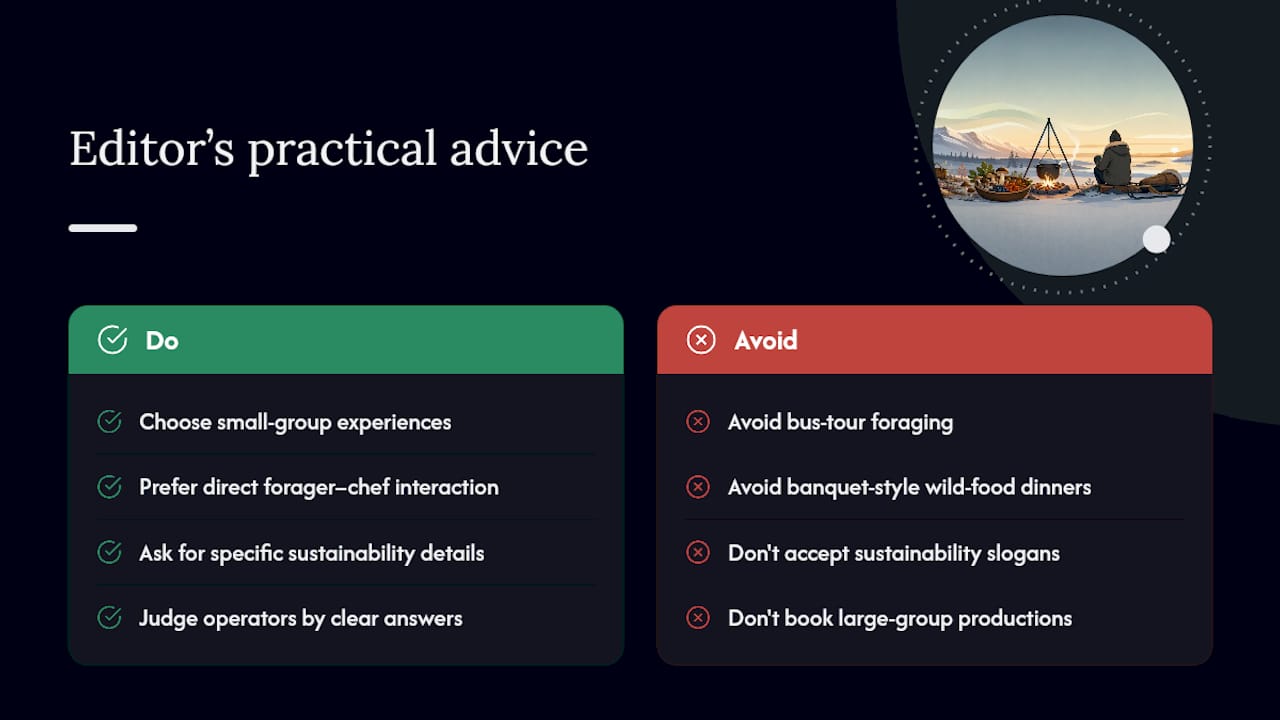
The villiruoka experiences worth booking in Lapland are rarely the biggest ones. Scale works against authenticity here. Once a foraging trek turns into a bus tour or a wild-food dinner becomes a banquet hall production, the story behind each ingredient gets flattened. What makes this food matter is the direct line between a forager, a chef, and your plate, and that line only holds in small groups.
Sustainability claims in this space deserve real scrutiny too. Ask for specifics, not slogans, and judge an operator on whether they can answer plainly.
— Juho
Book a Wild-Food Experience With Sunday Morning Collection
Sunday Morning is the direct route to villiruoka in Pyhä-Luosto, without hunting through scattered listings to piece together a season-accurate menu yourself. At Restaurant Aihki, chef Anssi Riihimäki builds tasting menus around Arctic char, reindeer, and whatever wild herbs and berries are peaking that week, and pairs each course with the outdoor activities that put those ingredients in context.
If you want a gourmet wild-food dinner alongside guided nature experiences and a comfortable base to return to afterward, check current dates and book luxury accommodation in Pyhä-Luosto directly through Sunday Morning Collection.
Sources
- Villiruoka & Keräilyvaellus nuotiolounaalla — Lapland North Destinations
- Syötävät villiyrtit ovat nyt parhaimmillaan Lapissa — Yle
- Lapland regional food: signature ingredients — Ruokatieto / Finland
- Poro- ja kalatalous osaksi Lapin kiertotaloutta — Kestävyysloikka
