


TL;DR:
- Arctic wildlife encounters involve extended, responsible observations of species like polar bears, narwhals, and Arctic foxes in their natural habitats. Timing, location, patience, and adherence to safety guidelines greatly influence the quality and ethics of these experiences. Flexible itineraries and respectful practices ensure memorable and sustainable encounters with Arctic wildlife.
Arctic wildlife encounters are defined as direct, extended observations of wild species in their natural polar habitat, ranging from a polar bear resting on pack ice to a narwhal pod surfacing at midnight. The Arctic holds some of the most concentrated and dramatic animal sightings on Earth, across regions like Svalbard, Greenland, the Canadian Arctic, and Alaska. Species like polar bears, narwhals, Arctic foxes, walruses, and vast seabird colonies each offer a completely different kind of experience. This article walks you through the most memorable and inspiring examples, with practical details on where, when, and how to witness them responsibly.
1. Examples of arctic wildlife encounters: polar bears up close
Polar bear sightings are the defining wildlife experience in the Arctic, and Svalbard delivers the most reliable ones. Summer months in Svalbard, specifically June through August, offer the best conditions because bears remain active near accessible sea ice and seal hunting grounds. July and August are peak months, when bears concentrate near remaining pack ice close to seal colonies.
Real encounters vary widely in intensity. In spring 2026, a woman in St. Anthony, Newfoundland, filmed a polar bear roughly 50 feet from her yard during the northward spring migration, describing it as a “complete adrenaline rush.” On Svalbard expeditions, encounters typically happen from the water, with safety teams maintaining a 500-meter viewing distance and evacuating shore groups when bears approach within one to two miles.
What makes polar bear encounters so compelling is the behavior you get to observe. Bears swim between ice floes, stalk seals with slow deliberate movements, or simply rest in the sun. Each of these behaviors tells you something real about how they survive.
- Best locations: Svalbard (Spitsbergen), Greenland’s east coast, and the Canadian Arctic around Churchill and Nunavut
- Best timing: June through August for sea ice access; October through November in Churchill for bears waiting for freeze-up
- What to expect: Sightings from zodiacs or expedition vessels, rarely on foot
- Common behaviors: Swimming, resting, hunting seals, mother-cub interactions
Pro Tip: Book an expedition cruise rather than a land-based tour for polar bear sightings. Vessels can follow ice conditions in real time and reposition overnight, dramatically increasing your chances.
2. How narwhal encounters differ from other Arctic experiences
Narwhal sightings stand apart from every other Arctic animal encounter because of how long and how closely they can be observed. In Greenland’s Inglefield Bredning, researchers using Inuit hunting platforms observed 506 narwhals over six days, with individual appearances lasting up to 13 hours. That kind of sustained observation is almost unheard of with other marine mammals.
The pattern of narwhal appearances follows a clear diurnal rhythm. Animals surface most frequently between noon and midnight, then become intermittent or absent in early morning hours. Drone footage captured during these studies revealed detailed behaviors including tusk-to-body ratios and social groupings that were previously impossible to document from boats alone. This integration of Inuit knowledge with scientific observation has transformed how researchers and travelers understand narwhal behavior.
For travelers, a narwhal excursion requires patience and structure. Here is what a realistic narwhal encounter looks like:
- Arrive at the observation site by late morning. Narwhals are most active from noon onward, so early arrivals often see nothing.
- Stay quiet and low. Narwhals are sensitive to noise and movement on the water’s surface.
- Watch for the tusk first. The spiral tusk of a male can extend up to 10 feet and often breaks the surface before the body is visible.
- Expect gaps in activity. Pods disappear for stretches of 30 to 60 minutes before resurfacing nearby.
- Use binoculars, not just your eyes. Narwhals surface briefly and at distance, so magnification makes the difference between a glimpse and a genuine sighting.
Narwhal encounters reward patience above all else. The observers who stay longest see the most. A six-hour wait followed by an hour of pod activity is a completely normal and deeply satisfying experience.
3. Arctic fox cubs and other remarkable wildlife moments
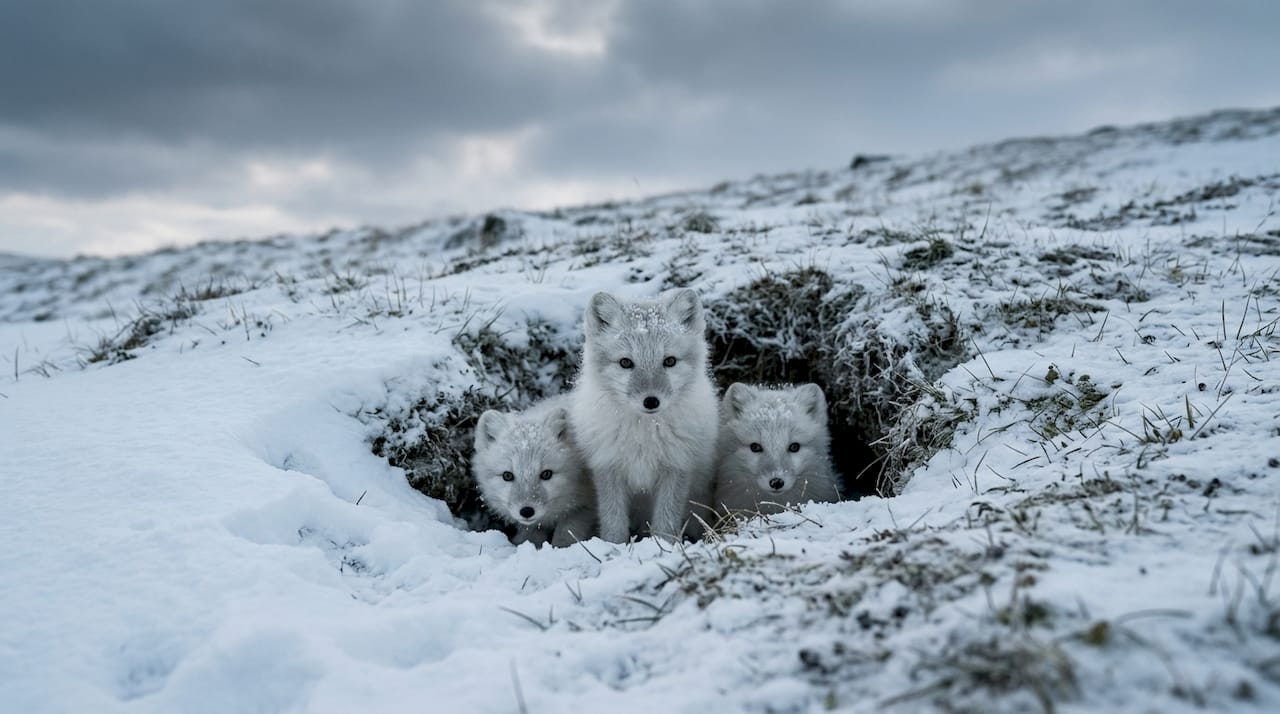
Beyond polar bears and narwhals, the Arctic offers wildlife experiences that are quieter but equally memorable. Arctic fox cubs are among the most charming encounters you can have. On Spitsbergen, observers have watched fox cubs playing on beaches near bird colonies while their mother sheds her thick white winter coat, transitioning to the gray-brown summer fur. The cubs tumble over each other, investigate rocks, and occasionally steal scraps from nearby nesting birds.
Walrus haul-outs are a completely different kind of spectacle. Hundreds of walruses pile onto rocky beaches or ice floes, producing a wall of sound and smell that hits you before you see them. When a polar bear approaches a haul-out, the entire group surges into the water in seconds. Watching that reaction gives you a visceral sense of Arctic predator-prey dynamics that no documentary fully captures.
Seabird colonies add scale to the experience. Svalbard expeditions regularly encounter thousands of little auks, puffins, and Brünnich’s guillemots nesting on cliff faces. The noise and movement of a colony of 10,000 birds is genuinely overwhelming in the best possible way.
- Arctic foxes: Best seen near bird colonies in summer; cubs visible June through August
- Walruses: Haul-outs at Prins Karls Forland in Svalbard and Round Island in Alaska
- Puffins and guillemots: Cliff colonies throughout Svalbard, Iceland, and Greenland
- Ringed and bearded seals: Common on ice floes throughout the Arctic summer
- Reindeer: Svalbard reindeer graze near shorelines and are often spotted from expedition vessels
Pro Tip: Walrus haul-outs are best approached from downwind and at a low angle. Walruses have poor eyesight but excellent hearing and smell. A quiet, slow approach from the right direction can get you within respectful viewing distance without triggering a stampede.
4. How seasons and geography shape your wildlife experience
The timing and location of your trip determine almost everything about which animals you see and how close you get. Summer, specifically June through August, is the peak period for most Arctic animal sightings. Sea ice is accessible but not overwhelming, marine mammals are active near the surface, and 24-hour daylight means you can observe at any hour.
Geography matters just as much as timing. Svalbard sits at the intersection of the warm North Atlantic Current and cold Arctic waters, creating nutrient-rich conditions that support dense wildlife populations. Greenland’s fjords funnel narwhals and belugas into predictable corridors. Alaska’s North Slope, including the area around Utqiagvik, offers bowhead whale encounters tied closely to sea ice patterns.
| Location | Key species | Best months | Notes |
|---|---|---|---|
| Svalbard, Norway | Polar bears, walrus, Arctic fox, seabirds | June to August | Expedition cruises most effective |
| Greenland (Inglefield Bredning) | Narwhals, musk oxen, polar bears | July to August | Inuit-guided tours recommended |
| Canadian Arctic (Nunavut) | Polar bears, beluga whales, caribou | July to October | Churchill famous for fall bear season |
| Alaska (Utqiagvik) | Bowhead whales, polar bears, Arctic foxes | May to July | Ice conditions highly variable |
| Finnish Lapland | Reindeer, wolverines, Arctic birds | Year-round, peak winter | Arctic wildlife in Lapland accessible from luxury bases |
Ice conditions can shift encounter windows significantly. In Utqiagvik in 2026, unusual ice conditions delayed the first spring whale landing until May 23, later than any recent season. Flexible itineraries that allow for repositioning based on current conditions consistently produce better results than fixed schedules.
5. Safety and ethics during Arctic wildlife encounters
Responsible wildlife observation protects both you and the animals. The most important rule is distance. Federal guidelines establish a 1.6-kilometer buffer zone for polar bears during aerial surveys, with data showing that 99% of bears showing signs of disturbance were within that distance of the aircraft. The same principle applies on the ground and water: closer is not always better, and disturbance changes animal behavior in ways that can last long after you leave.
Polar bear behavior in response to human presence is highly variable, which is exactly why conservative planning is the only safe approach. Some bears ignore observers entirely. Others react at distances that seem safe by casual standards. Expedition leaders use current research rather than fixed folklore distances to manage encounters.
Practical safety and ethics checklist:
- Never approach wildlife on foot without a trained guide carrying a firearm in polar bear territory
- Stay in your zodiac or vessel when bears are visible on shore
- Keep noise minimal near all species, especially seabirds during nesting season
- Follow your guide’s instructions immediately when asked to retreat
- Do not feed, bait, or attempt to attract wildlife under any circumstances
- Respect nesting and denning areas by maintaining extra distance during sensitive seasons
The goal of every Arctic wildlife encounter is to leave no trace on the animal’s behavior. An encounter that changes nothing about how the animal acts is a successful one.
Key takeaways
Arctic wildlife encounters reward preparation, patience, and respect. The most memorable and ethical experiences come from choosing the right location, timing your visit to match species behavior, and following evidence-based safety guidelines throughout.
| Point | Details |
|---|---|
| Timing drives encounter quality | June to August is the most reliable window for polar bears, narwhals, and marine mammals across Svalbard and Greenland. |
| Narwhals require patience | Observations can last up to 13 hours; expect gaps and plan for a full-day excursion rather than a quick sighting. |
| Distance rules protect everyone | A 1.6 km buffer for polar bears is backed by federal disturbance data, not guesswork. |
| Geography matters as much as season | Each Arctic region offers distinct species; Svalbard, Greenland, and Finnish Lapland each deliver different encounters. |
| Flexible itineraries outperform fixed ones | Ice conditions in 2026 shifted whale seasons by weeks; adaptable plans consistently produce better wildlife results. |
What I’ve learned from years of watching the Arctic
By Juho
The encounters that stay with you are rarely the ones you planned. I have watched a polar bear swim between ice floes for 40 minutes from a zodiac, completely indifferent to our presence. I have sat in silence on a Greenland shoreline while a narwhal pod surfaced 200 meters away, tusks catching the midnight sun. Neither moment was on a printed itinerary.
What I have come to believe is that the Arctic rewards a particular kind of traveler: one who is genuinely curious, genuinely patient, and genuinely willing to let the environment set the pace. The travelers who push for closer access, who rush from one sighting to the next, consistently have worse experiences than those who settle in and observe.
Recent science has made me appreciate these encounters even more. Knowing that narwhal observations can extend for 13 hours, or that polar bear disturbance responses are individually variable, changes how you watch. You stop looking for a photo opportunity and start reading behavior. That shift makes every encounter richer.
My honest advice: build your Arctic trip around one or two species you genuinely want to understand, not a checklist of everything you can see. You will come home with fewer photos and far better stories. And if you are planning a trip that includes Finnish Lapland, the sustainable travel approach matters just as much as the destination itself.
— Juho
Plan your Arctic wildlife adventure with Sundaymorning
If Arctic wildlife experiences are what you are after, your base matters as much as your itinerary. Sundaymorning offers Arctic winter getaway packages designed for nature lovers who want both comfort and genuine wilderness access in Finnish Lapland. Pyhä-Luosto National Park sits at the heart of these experiences, with reindeer, wolverines, and Arctic birds accessible year-round from a warm, well-designed base.

Sundaymorning’s approach combines luxury Arctic accommodations with guided wildlife excursions and sustainable tourism practices that keep the environment intact for every visitor who comes after you. Whether you are planning a winter Northern Lights trip or a summer wildlife expedition, Sundaymorning builds the kind of itinerary that gives you real encounters, not staged ones.
FAQ
When is the best time to see Arctic wildlife?
June through August is the most reliable window for polar bears, narwhals, and marine mammals across Svalbard and Greenland, with 24-hour daylight and accessible sea ice supporting active wildlife behavior.
How close can you get to polar bears safely?
Federal disturbance guidelines support a 1.6 km buffer zone for polar bears, and expedition operators on Svalbard typically maintain 500 meters or more between observers and bears.
What makes narwhal sightings so rare?
Narwhals surface intermittently and follow a diurnal pattern, appearing most frequently between noon and midnight. Sightings require patience and a full-day commitment rather than a brief excursion.
What Arctic wildlife can you see in Finnish Lapland?
Finnish Lapland is home to reindeer, wolverines, Arctic foxes, and a wide range of Arctic bird species, all accessible through guided excursions from bases like those offered by Sundaymorning in Pyhä-Luosto National Park.
Do unusual ice conditions affect wildlife encounters?
Yes. In Utqiagvik, Alaska, a late ice breakup in 2026 pushed the first spring whale landing to May 23, weeks later than typical. Flexible travel plans that account for variable ice conditions consistently produce better results.
