


Pyhä-Luosto National Park packs fells, gorges, and roughly 101 kilometers of marked trails into one of Lapland’s quieter wilderness escapes. This Pyhä-Luosto kansallispuisto guide is built for day hikers, multi-day trekkers, and anyone chasing the Northern Lights with a camera in hand. Before you lace up your boots, check trail conditions with Luontokeskus Naava or Luontoon, since access changes sharply between summer and winter.
TL;DR:
- Trail access varies seasonally, with steep gorge routes like Isokuru closing during snow and ice, making winter activities limited mainly to snow routes and Aurora viewing.
- The park offers a mix of challenging day hikes and multi-day trails with designated huts, but resupply options are limited, requiring careful planning for longer excursions.
- Proper layering, sturdy boots, and offline navigation are essential since weather can change rapidly, and some paths, especially near gorge rims, may be unsafe in winter.
- Tourism infrastructure includes visitor centers, guided tours, and nearby sustainable accommodation, with guided activities recommended for deeper cultural and geological insights.
- Visiting during late spring, early summer, or winter’s dark months offers the best wildlife and Aurora viewing, but timing is key due to short windows for specific species and seasonal conditions.
Table of Contents
- Pyhä-Luosto National Park Quick Facts
- What Are the Best Hiking Trails in Pyhä-Luosto?
- When Are Trails Closed or Restricted in Pyhä-Luosto?
- How Should You Prepare for a Pyhä-Luosto Hike?
- Visitor Services, Transport, and Where to Base Yourself
- How Is Pyhä-Luosto National Park Protected?
- What Wildlife and Plants Live in Pyhä-Luosto?
- What Cultural History Shapes Pyhä-Luosto?
- Are There Guided Tours Available in Pyhä-Luosto?
- When Is the Best Time to See Wildlife in Pyhä-Luosto?
- A Local Perspective on Pyhä-Luosto’s Quiet Season
- Where to Stay Near Pyhä-Luosto After a Day on the Trails
- Sources
Pyhä-Luosto National Park Quick Facts
Pyhä-Luosto covers about 142 square kilometers, spanning the municipalities of Kemijärvi, Pelkosenniemi, and Sodankylä. The modern park took shape in 2005, but its oldest protected section dates back to 1938, making it one of Finland’s longest-standing conservation areas. That history matters if you’re the type of hiker who likes knowing the ground beneath your boots has been protected for generations, not just decades.
The park holds close to 101 kilometers of marked trails, ranging from short afternoon loops to treks that take two or three days to finish properly. A handful of landmarks anchor almost every itinerary you’ll plan here:
- Isokuru — the park’s deepest gorge, dramatic and steep-walled
- Noitatunturi — a fell with sweeping views and a demanding climb
- Ukko-Luosto — a scenic summit with a sheltered viewing hut
- Lampivaara — home to Europe’s only amethyst mine open to visitors
- Luontokeskus Naava — the park’s visitor centre and planning hub
Knowing these five names before you arrive saves you from squinting at a trailhead map wondering what’s actually worth the climb.
What Are the Best Hiking Trails in Pyhä-Luosto?
Route choice in Pyhä-Luosto comes down to how much time you have and how much elevation you’re willing to earn. The park’s official route booklet lays out exact distances and facility locations, and it’s worth downloading before you go.
- Noitatunturi (14 to 15 km) climbs toward Isokuru, the park’s signature gorge, and rewards you with some of the sharpest topography in the region. Most hikers tackle it as a long day trip, starting early to have soft morning light for photos at the gorge rim. Seasonal access matters here: the steepest sections near Isokuru are only safe snow-free, so save this one for late spring through early fall.
- Ukko-Luosto offers two distinct experiences. A 6.5-kilometer steps loop gets you to the summit fast, with a genuinely tough staircase climb near the top. The longer 18-kilometer nature trail loops wider through forest and fell terrain. Both end at the Ukko-Luosto scenic hut, a sheltered spot that’s ideal for warming up while watching for the Northern Lights without standing exposed on an open ridge.
- The Pyhä-Luosto long trail (30 km) connects the two fell areas and typically takes two to three days. Overnight options along the way include unstaffed wilderness huts (autiotuvat) and open-sided shelters (laavus), so you don’t need to carry a tent if you plan your stops well. Resupply is limited, so pack accordingly.
- Tunturiaavan luontopolku (7 km) and the Imäkuru loop (12 km) are the gentler choices, both manageable in half a day and friendlier for families or anyone easing into fell walking.
For a half-day outing, start at Naava and do the Tunturiaavan loop. For a full day, tackle Noitatunturi from Luostonportti. For a multi-day trip, begin at either Naava or Luostoloma and follow the 30-kilometer trail toward Pyhätunturi, booking a hut stay in advance where possible.
Pro Tip: Hike Noitatunturi toward Isokuru in the morning rather than the afternoon. The gorge walls catch low sunlight best before midday, and you’ll beat the midsummer crowds that build up by early afternoon.
When Are Trails Closed or Restricted in Pyhä-Luosto?
Isokuru’s steepest approach paths and several upper-fell sections close informally once snow and ice set in, and Metsähallitus flags avalanche risk in the gorge during winter and early spring. This isn’t a park with rigid gate closures. It’s a park where conditions decide for you, and ignoring that is how hikers get into trouble.
Winter still has plenty to offer, just through different activities. Fatbiking on groomed trails, snowshoeing across marked winter routes, and Aurora-watching from Ukko-Luosto’s scenic hut all work well once the fells are locked in snow. Some summer-only paths simply don’t reopen until the thaw, typically running from late May through September for the higher routes.
Before any visit, confirm current conditions through these channels:
- luontoon.fi’s official trail and rules page
- Luontokeskus Naava staff, in person or by phone
- Downloadable trail maps and PDFs from Metsähallitus
Roughly 101 kilometers of trail exist on paper, but the usable share shifts with the season, sometimes by a third or more once winter closes the gorge routes.
How Should You Prepare for a Pyhä-Luosto Hike?
Layering matters more here than almost any single piece of gear. Fell weather swings fast, and you’ll want a moisture-wicking base, an insulating mid-layer, and a windproof shell you can strip down or add back within minutes.
Footwear needs to handle rakkakivi, the loose boulder fields common on fell approaches, along with exposed tree roots on forested sections. Sturdy hiking boots with ankle support are the baseline. If you’re visiting outside the snow-free window, bring crampons or snowshoes rather than hoping the trail stays packed and even.

Navigation deserves real attention. Mobile coverage drops out in deep sections of Isokuru, so download offline maps through Luontoon.fi before you lose signal, and carry a physical map as backup. A dead phone battery shouldn’t be the reason you’re guessing at a fork in the trail.
Metsähallitus asks visitors to stay on marked trails, follow campfire restrictions, and pack out everything they bring in. Fragile Arctic ground cover recovers slowly from off-trail foot traffic, sometimes over years rather than seasons.
- Pack layered clothing and a windproof shell
- Wear sturdy boots suited to loose rock and roots
- Bring crampons or snowshoes outside the snow-free season
- Download offline maps and carry a physical backup
- Check in with Naava for current advisories before setting out
Pro Tip: Set a firm turn-back time before you start, not once you’re tired. If you’re not past Isokuru’s rim by early afternoon on a day hike, turn around. Fell light fades faster than you expect.
Visitor Services, Transport, and Where to Base Yourself
Luontokeskus Naava functions as the park’s front door. Staff there offer trail advice tailored to current conditions, and the center runs a geology and history exhibition worth an hour on its own, particularly useful for orienting yourself before a longer route. Visitors who stop at Naava first tend to make better route decisions once they’re actually on trail.
Getting there without a car is workable but requires planning. Buses connect Rovaniemi and Kemijärvi to the Pyhä and Luosto areas, though schedules thin out significantly outside peak winter and summer weeks. Taxis fill the gaps for the final stretch to specific trailheads.
Key parking and starting points to know:
- Luostonportti — main trailhead access near Luosto village
- Luostoloma — secondary parking and route access point
- Naava — visitor centre with parking and trail information
On-trail infrastructure includes autiotuvat and laavus along the longer routes, plus a seasonal café near the Lampivaara amethyst mine. For guided hikes, amethyst mine tours, or gear rental, check pyha.fi and local operators directly, since availability shifts by season.
How Is Pyhä-Luosto National Park Protected?
Pyhä-Luosto’s conservation status isn’t decorative. The park’s core purpose, since its 1938 origins and its 2005 expansion, has been protecting fell ecosystems and old-growth forest that took centuries to establish. Metsähallitus manages the land with a straightforward operating principle: keep foot traffic on marked trails so the surrounding tundra vegetation, lichen fields, and peat can regenerate undisturbed.
Fire restrictions are strict and specific. Open fires are permitted only at designated sites, a rule that matters more in a landscape where a single careless spark could damage vegetation that took decades to grow back. Waste management follows a strict carry-in, carry-out policy across the entire park, with no assumption that bins will appear conveniently along the trail.
The gorge systems, particularly Isokuru, receive extra protection because their microclimates support plant species that don’t survive elsewhere in the region. Straying off-path near gorge rims isn’t just a personal safety risk. It disturbs ground that can take years to recover from a single set of boot prints in the wrong season.
Metsähallitus also monitors visitor numbers against ecological capacity, adjusting guidance seasonally rather than applying a blanket rule year-round. That’s part of why checking current advisories before a visit matters as much for conservation as it does for your own safety.
What Wildlife and Plants Live in Pyhä-Luosto?
Pyhä-Luosto sits at the meeting point of fell tundra and boreal forest, which gives it an unusually wide range of habitats packed into a relatively compact park. Reindeer are the animal most visitors encounter, grazing freely across both open fell and forest edges since herding rights predate the park itself.
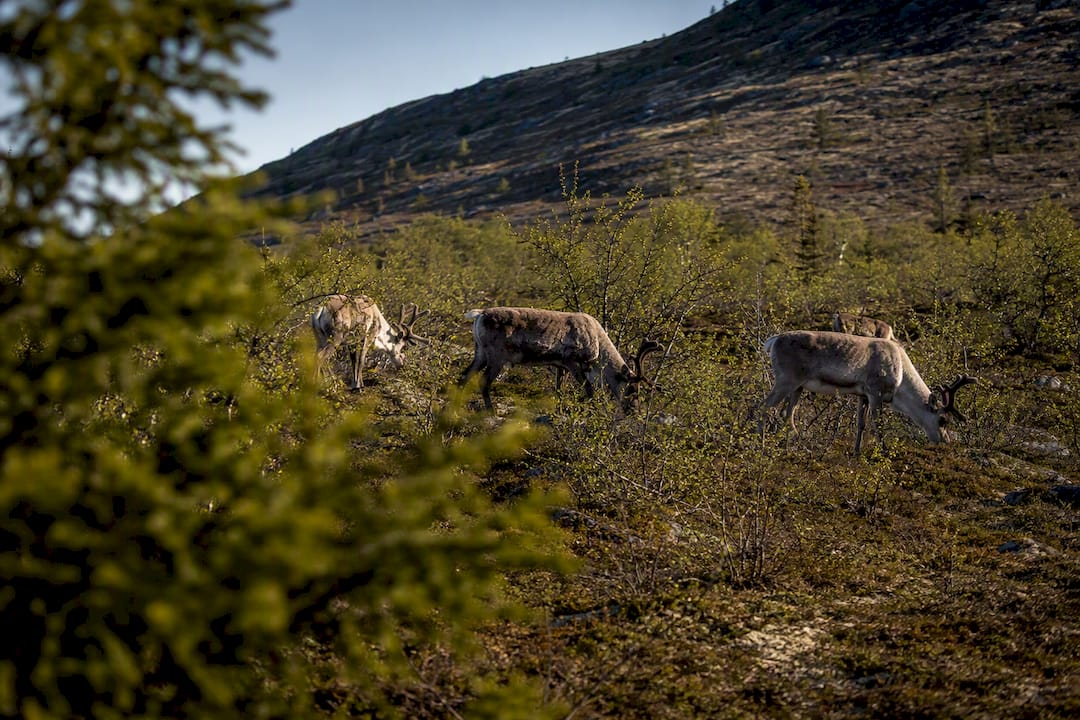
Golden eagles nest in the more remote fell sections, and the sharp-eyed occasionally spot Siberian jays flitting through spruce stands near the trails. Mountain hares shift coat color with the seasons, turning nearly invisible against snow from late autumn through spring.
Below the tree line, old-growth spruce and pine forest gives way to dwarf birch and hardy tundra plants as you climb toward the fells. Cloudberries and bilberries carpet sections of the lower trails in late summer, a detail seasoned hikers plan around since picking is generally allowed for personal use outside protected zones. Alpine flora clings to rocky outcrops near the summits, plants adapted to a growing season measured in weeks rather than months.
The gorge microclimates support their own specialized plant communities, sheltered from wind in a way the open fells aren’t. That’s part of why Isokuru draws naturalists as much as photographers, even though its terrain demands more caution than most other routes in the park.
What Cultural History Shapes Pyhä-Luosto?
Long before Pyhä-Luosto became a national park, the area held spiritual significance for the Sámi, Finland’s Indigenous people. The name “Pyhä” itself translates to “sacred,” a direct reference to how the fells were regarded in Sámi tradition as places connected to the divine rather than simply scenery.
Reindeer herding, a practice with deep Sámi roots, continues in and around the park today, which is why hikers occasionally encounter grazing herds mid-trail. This isn’t staged for tourists. It’s a working tradition that predates the park boundary by centuries and continues largely unchanged in practice.
The park’s amethyst mine at Lampivaara adds another historical layer, tied to more recent mining history rather than ancient use, and now operates as a visitor attraction where guests can dig for their own gemstones under supervision. It sits alongside the older Sámi cultural landscape as a reminder that this terrain has drawn people for very different reasons across very different eras.

Understanding this layered history changes how the landscape reads on the trail. A fell that looks like simple wilderness carries centuries of meaning for the people who called it sacred first, and that context is worth carrying with you as much as a map or water bottle.
Are There Guided Tours Available in Pyhä-Luosto?
Guided hikes make sense for visitors who want deeper interpretation than a trail map alone provides, particularly around Sámi cultural context or gorge geology that’s easy to walk past without understanding. Local operators run guided treks to Isokuru, Noitatunturi, and the Lampivaara amethyst mine, often pairing the walk with historical or geological explanation you won’t get from signage alone.
Luontokeskus Naava is the best starting point for finding legitimate, currently operating guides, since staff there track which local operators are active each season. For amethyst mine visits specifically, pyha.fi lists current tour operators and booking options, since access to the working mine site typically requires a guide rather than independent hiking.
Winter brings additional guided options, including Aurora-focused excursions that combine short hikes with extended waiting periods at dark-sky viewing spots. These tend to work better with a guide than solo, mostly because knowing where light pollution is genuinely absent takes local knowledge that isn’t always obvious from a map.
When Is the Best Time to See Wildlife in Pyhä-Luosto?
Late spring through early summer offers the clearest wildlife viewing window, when reindeer calves appear and birds return to nest after winter. Long daylight hours, stretching close to around-the-clock light by June, extend your viewing time well beyond what a typical hiking day allows further south.
Autumn, locally called ruska, turns the dwarf birch and tundra plants brilliant shades of red and gold, typically peaking in September. It’s a shorter window than most visitors expect, often lasting only two or three weeks, so timing a visit around it takes some flexibility.
Winter shifts the spectacle skyward. Aurora activity peaks during the darkest months, roughly November through March, and the park’s distance from major light pollution makes it a genuinely strong viewing location compared to more built-up parts of Lapland. Mountain hares in winter coat and reindeer against snow make for striking, if brief, wildlife sightings during shorter daylight hours.
Each season rewards a different kind of patience, whether that’s waiting out cloud cover for the lights or timing a hike to catch the ruska color at its peak before it fades.
A Local Perspective on Pyhä-Luosto’s Quiet Season
What strikes me most about Pyhä-Luosto is how little it competes for your attention. Compared with busier Lapland resorts, this park stays genuinely quiet, especially on weekday mornings when Isokuru’s rim belongs almost entirely to whoever got there first. Early winter and the tail end of ruska season tend to reward that patience best.
Pairing a demanding day on the fells with a comfortable, sustainably run place to recover afterward makes a real difference. Eco-conscious lodging near the Luosto trailheads cuts down your morning transfer time and gives you a warm, quiet place to thaw out before an evening Aurora watch. Start your planning at Naava, then choose accommodation close to the trailheads so early starts don’t mean an hour of driving before you’ve even laced up your boots.
— Juho
Where to Stay Near Pyhä-Luosto After a Day on the Trails
There are warm, sustainable places to recover minutes from the routes you just walked. Boutique resorts and apartments sit close enough to the Luosto trailheads to allow early starts and relaxing sauna visits before dinner.
Some bookings may include add-ons like Aurora tours, husky safaris, and guided nature excursions, avoiding last-minute arrangements for local operators. Pro Tip: Book guided activities and Aurora tours ahead of peak winter weeks, since local guides fill their calendars fast once the darkest months arrive.
If you’re weighing where to land after a long day at Isokuru or Ukko-Luosto, browse luxury accommodation options in Lapland and check available dates directly through Sundaymorning’s booking page.
